
Northwestern Russia is a region of Russia stretching from the major population center of Leningrad Oblast on the Baltic Sea to vast, remote, and empty lands above the Arctic Circle.
- Saint Petersburg. — Russian "window to the West", the second largest city in Russia, and the most touristic one. Included into 10 top European tourist cities ranking.
- Arkhangelsk. — a key northern port of Russia, cultural capital of Russian north, and the gateway to Solovki and Nenetsia.
- Murmansk. — the world-largest transpolar city with a big ice-free port (thanks to Golfstream) and Navy surroundings.
- Novgorod., or Velikiy Novgorod — one of the oldest Russian cities, established in 9th century, famous as the capital of ancient Novgorod Republic, and once a part of Hansa cities union. The city has great cultural heritage and definetily worth visiting.
- Petrozavodsk. — the capital of Karelia and the gateway to Kizhi. Beautiful lakeside embankment with strange sculptures.
- Pskov. — another ancient city, the neighbour of Novgorod. Picturesque kremlin (Krom) and old city.
- Veliky Ustyug. in Vologda Oblast — official residence of Father Frost (Ded Moroz), Russian equivalent of Santa Claus.
- Vologda.
- Vyborg. — once a Swedish and Finnish fortress, now this is the closest town of Leningrad Oblast on the way from Finland to Saint Petersburg. Vyborg has European look, fortress and old city are beautiful.
Saint Petersburg. — Russian "window to the West", the second largest city in Russia, and the most touristic one. Included into 10 top European tourist cities ranking.
Arkhangelsk. — a key northern port of Russia, cultural capital of Russian north, and the gateway to [[Solovetsky Islands|Solovki]] and [[Nenetsia]].
Murmansk. — the world-largest transpolar city with a big ice-free port (thanks to Golfstream) and Navy surroundings.
Novgorod., or Velikiy Novgorod — one of the oldest Russian cities, established in 9th century, famous as the capital of ancient Novgorod Republic, and once a part of Hansa cities union. The city has great cultural heritage and definetily worth visiting.
Petrozavodsk. — the capital of [[Karelia]] and the gateway to [[Kizhi]]. Beautiful lakeside embankment with strange sculptures.
Pskov. — another ancient city, the neighbour of [[Novgorod]]. Picturesque kremlin (Krom) and old city.
Veliky Ustyug. in [[Vologda Oblast]] — official residence of Father Frost (Ded Moroz), Russian equivalent of Santa Claus.
Vologda.
Vyborg. — once a Swedish and Finnish fortress, now this is the closest town of [[Leningrad Oblast]] on the way from [[Finland]] to [[Saint Petersburg]]. Vyborg has European look, fortress and old city are beautiful.
- Kirillo-Belozersky Monastery.
- Kizhi. — a Lake Onega. island in Karelia, famous for its awesome wooden architectural ensemble.
- Lake Ladoga.
- Pushkinskie Gory. — the estate and museum of Alexander Pushkin, a world-known Russian poet.
- Solovki.
- The museum towns near Saint Petersburg: Peterhof., Pushkin., and Pavlovsk., with luxury Tsar palaces and astonishing parks with fontains.
- Valaam. — monastery in Karelia, located at an island in Ladoga lake.
- Valday National Park.
- Virgin Komi Forests. — the largest unspoilt forested area in Europe, a UNESCO World Heritage site with two protected territories: Yugyd Va National Park and Pechora Ilych Nature Reserve.
Kirillo-Belozersky Monastery.
Kizhi. — a Lake Onega. island in [[Karelia]], famous for its awesome wooden architectural ensemble.
Kizhi. — a Lake Onega. island in [[Karelia]], famous for its awesome wooden architectural ensemble.
Lake Ladoga.
Pushkinskie Gory. — the estate and museum of Alexander Pushkin, a world-known Russian poet.
Solovki.
The museum towns near [[Saint Petersburg]]: Peterhof., Pushkin., and Pavlovsk., with luxury Tsar palaces and astonishing parks with fontains.
The museum towns near [[Saint Petersburg]]: Peterhof., Pushkin., and Pavlovsk., with luxury Tsar palaces and astonishing parks with fontains.
The museum towns near [[Saint Petersburg]]: Peterhof., Pushkin., and Pavlovsk., with luxury Tsar palaces and astonishing parks with fontains.
Valaam. — monastery in Karelia, located at an island in [[Ladoga]] lake.
Valday National Park.
Virgin Komi Forests. — the largest unspoilt forested area in [[Europe]], a [[UNESCO World Heritage site]] with two protected territories: [[Yugyd Va National Park]] and [[Pechora Ilych Nature Reserve]].
Northwestern Russia has long vied with Central Russia for political and cultural preeminence, first under the trading center of the Novgorod Republic, later under Peter The Great's creation Saint Petersburg. Saint Petersburg, having lost the capital status to Moscow under the Soviet regime, retains its popular image as Russia's Northern Capital, window to Europe, and in the eyes of many remains the nation's foremost cultural center for its unparalleled museums, art galleries, classical music, and architectural history. Just outside the city are three staggeringly beautiful and enormous Tsarist palaces at Peterhof, Pushkin, and Pavlovsk.
Not far from Saint Petersburg are a few other small cities with rich history—especially Novgorod, which is a must-see attraction for visitors to the region, but also Pskov and the twin castle cities of Ivangorod and Narva (Narva being across the river in present-day Estonia). Further off the beaten path, but still possible as day trips from Saint Petersburg are small towns such as Staraya Ladoga, the birthplace of Russia, and Staraya Rusa, Dostoevsky's rural retreat, where he wrote and set The Brothers Karamazov.
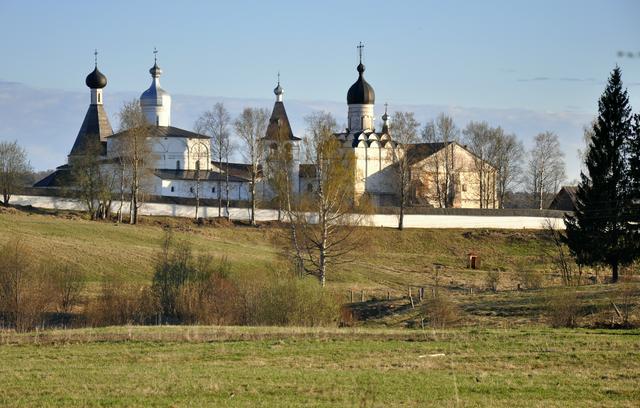
Far further from Saint Petersburg and isolated from major population centers are some of Russia's most important sights, which are hard but rewarding to get to. Kizhi Island, a tiny island in Lake Onega, is home to some of Russia's most important and beautiful intricate wooden architecture. Isolated and breathtaking fourteenth century Kirillo-Belozersky Monastery in Vologda Oblast, on the shores of Siversky Lake, was once one of the wealthiest landowners of all Russia. Solovki in the White Sea is a singular destination; once one of the mightiest monasteries in Russia, and fortress of the White Sea, Solovki was turned into a notorious gulag under Stalin's reign.
For the most adventurous travelers, the North Seas await. Arkhangelsk is the principal port for giant Russian icebreakers heading out into the Barents Sea and off into the Arctic. Expensive tours are available via these great ships, which can take you to some of the most isolated lands in the world along the Russian north coast, Severnaya Zemlya, Novaya Zemlya, and all the way to the Russian Far East to Chukotka, Wrangel Island, and off to the Bering Sea.
Russian is the native language of the majoraty of Northwestern Russia inhabitants. Important minority languages are: Finnish, Karelian and Veps languages in Karelia republic and Komi language in Komi republic. Almost all Finnish, Karelian, Komi and Veps speakers are bilingual and are fluent in Russian, aside from their native languages.
Basic English is widely understood in big cities, while in smaller cities and the countryside it can be very difficult to find an English speaker. German can also be useful. Older generations (over 30 years old) are less familiar with foreign languages than younger people.
- Nordic countries