
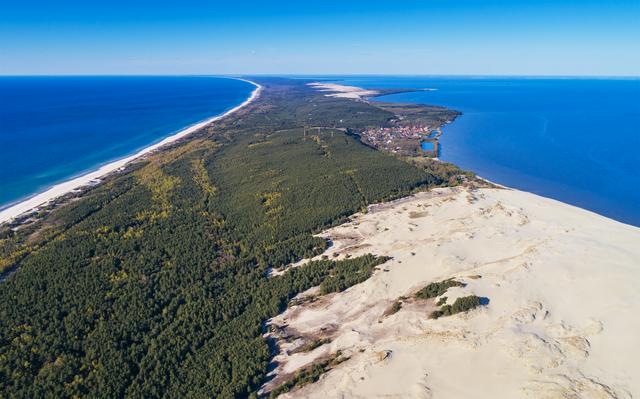
The Curonian Spit is a 98-km long narrow sandy peninsula at the Baltic Sea, enclosing the Curonian Lagoon. It is a bi-national UNESCO World Heritage Site shared by Lithuania and Russia. The town of Neringa is on the Spit.
Stretching from the Sambian peninsula in the south to the Lithuanian port city of Klaipėda in the north, the Curonian Spit is a narrow (400 m wide at its narrowest point and 4 km wide at its widest) peninsula. The northern part belongs to Lithuania, while the southern park is in Kaliningrad Oblast in Russia. It has been a UNESCO World Heritage Site since 2000 and has the status of national park in both countries.
Curonia was conquered by the Teutonic Order in the 13th century, and remained under German rule until World War I. While fishing was the major occupation of the Spit's inhabitants in the Middle Ages, tourism has flourished in the area since the start of the 20th century.
The Curonian Spit contains the largest drifting sand dunes in Europe. The highest of them rise up to 60 meters. The area is generally covered with forests, that constitute about 70 percent of land.
For flora and fauna, head down to the Curonian Lagoon, where the highest sand dunes in Europe are located. In order to protect the sand dunes, wooden broad walks have been built above them to enable visitors to marvel at the desert-like scenery without causing damage. You may spot some wildlife. Along the way, it is worthwhile to find the 'Dancing Forest' or 'The Drunkards' Forest', where tree trunks are curled and twisted from their roots and "Efa's dune". It is a magnificent sight to step into a forest of trees that look like over-sized bonsai.
A car or a motorbike entering Neringa municipality that contains most of the spit on the Lithuanian side is charged an ecological fee of, and campers are charged (2018 rates). A car entering the Russian part is charged .
Entering some of the nature reserves, including the border zone, is either limited or prohibited.
The Curonian Spit offers some of Europe's finest landscapes as well as cozy towns and villages. Two of the most impressive ranges of dunes are the Grey Dunes (or the Dead Dunes) north of the village of Pervalka and the range of dunes starting with Parnidžio dune just south of Nida and stretching into the Russia.
Between Morskoye and Rybachy, there is dancing forest where the trunks "dance".
On the Lithuanian side three of the most important settlements are Nida, Juodkrantė and Smiltynė (a part of Klaipėda city municipality).
The Curonian Spit is a popular summer holiday resort and a range of outdoor activities is available. The beaches of Nida, Juodkrantė and Smiltynė have been awarded the Blue Flag while the Curonian Lagoon presents opportunities to enjoy fishing or sailing.
For those more interested in culture there are several museums (including the Lithuanian Maritime Museum in the old fortress at the northern tip of the peninsula). The town of Juodkrantė has a rather interesting open air exposition (Hill of Witches) of wooden sculptures depicting mythological creatures. In the town of Nida there is a museum about the German writer Thomas Mann, who used to summer here. Between Rybachy and Lesnoy there is also the Curonian Spit museum which has history related to Rositten airfield.
- Smoked fish
- Amber souvenirs