
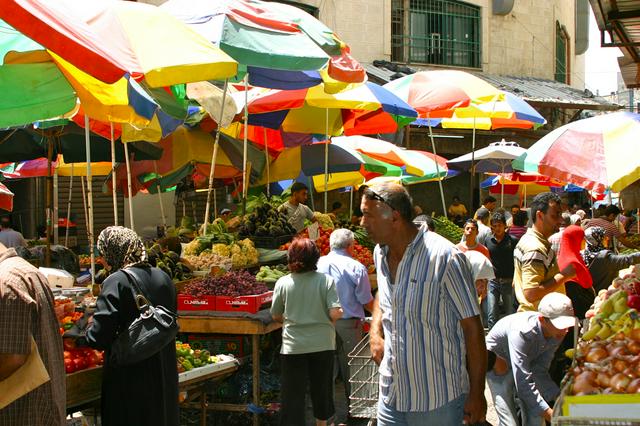
Ramallah (Arabic رام الله Rāmallāh) is a small city (population, approximately 57,000) in the Palestinian Territories, located within the West Bank region, some 15 km (10 miles) north of Jerusalem. Since the inception of the Palestinian National Authority, Ramallah has acted as the de facto capital city of the Palestinian administration.
Modern Ramallah was founded in the mid-16th century by the Haddadins, a Jordanian tribe of brothers descended from Ghassanid Christian Arabs. The Haddadins, led by Rashid Haddadin, arrived from east of the Jordan River near the Jordanian town of Shoubak. The Haddadin migration is attributed to fighting and unrest among clans in that area. According to modern living descendents of original Haddadin family members, Rahid's brother Sabra Haddadin was hosting Emir Ibn Kaysoom, head of a powerful Muslim clan in the region, when Sabra's wife gave birth to a baby girl. According to custom, the Emir proposed a betrothal to his own young son when they came of age. Sabra believed the proposal was in jest, as Muslim-Christian marriages were not customary, and gave his word. When the Emir later came to the Haddadins and demanded that they fulfill their promise, they refused. This set off bloody conflict between the two families. The Haddadins fled west and settled on the hilltops of Ramallah, where only a few Muslim families lived at the time. Today although town has a Muslim majority, Ramallah retains it's title as a historically Christian Palestinian town
Ramallah is known for its religiously relaxed atmosphere—alcohol flows freely and movie theaters are well attended—and the cafes along its main streets. Ramallah is, without question, the cultural capital of the West Bank, with a highly educated and fashionable population. It is also the hub of Palestinian feminist activity; the city’s women frequently attend university rather than marry early, and several cafes run exclusively by women are used to fund local feminist organizations.
While there, it is easy to make small talk with the locals. Unless you are firmly anti-Israeli occupation, it is advisable that you do more listening than actual talking yourself, however. For the most part, Palestinians are glad to share their problems and plight to any western visitors.
The city is one of the most vibrant ones in the West Bank. In Ramallah, a few historic and religious sites are present. However, the downtown streets are a must see during the day, as the city is often really congested.
- Hisbeh produce market, see below.
- Old City. While not resembling any 'Medina'-style old city, several churches and mosques can be found that may be of interest to visitors.
- The Friends Schools. One of the oldest schools in the region, are also a must visit as there is one near the old city, and another in the entrance of the downtown coming from Jerusalem.
- Yasser Arafat's mausoleum. 10am-5pm, except Mondays. The mausoleum is the only part of the Mukata'a two-block complex tourists can visit. You will be asked by the armed guards at the gate to leave any bags (large or small) with them but they will allow you to take your camera with you to visit the tomb. Inside you will find a couple of soldiers standing guard over the tomb. This seems to be a ceremonial guard and they will not object to your taking photos inside there, even of yourself or others next to the marble gravestone. Next to the mausoleum is the museum building where Arafat was held under siege by the Israeli Army in 2002. The museum is interesting in a way that it displays the Palestinian, sometimes a little questionable but interesting view of the difficult past. Mausoleum is free - Museum is ₪5.
- The West Bank headquarters of the Palestinian Authority. Closed for public. The Mukata'a is a two-block compound with a white tower that is lit up at night and visible from most parts of the city. It contains some government offices and conference rooms, as well as the above mentioned Yasser Arafat's mausoleum.
- Dar Zahran Heritage Building. Mon-Sat, opens 11am. A protected and family-owned building and one of the top sights in Ramallah, displaying the history and art of Ramallah's past and present. A nice and helpful host takes care of the place with over 200 years of history. It is also a hotel and you can buy souvenirs.
- Al Tireh. A fortress from the 12th century.
Hisbeh produce market, see [[#Buy|below]].
Old City. While not resembling any 'Medina'-style old city, several churches and mosques can be found that may be of interest to visitors.
- The Friends Schools. One of the oldest schools in the region, are also a must visit as there is one near the old city, and another in the entrance of the downtown coming from Jerusalem.
Old City. While not resembling any 'Medina'-style old city, several churches and mosques can be found that may be of interest to visitors.
- The Friends Schools. One of the oldest schools in the region, are also a must visit as there is one near the old city, and another in the entrance of the downtown coming from Jerusalem.
Yasser Arafat's mausoleum. 10am-5pm, except Mondays. The mausoleum is the only part of the Mukata'a two-block complex tourists can visit. You will be asked by the armed guards at the gate to leave any bags (large or small) with them but they will allow you to take your camera with you to visit the tomb. Inside you will find a couple of soldiers standing guard over the tomb. This seems to be a ceremonial guard and they will not object to your taking photos inside there, even of yourself or others next to the marble gravestone. Next to the mausoleum is the museum building where Arafat was held under siege by the Israeli Army in 2002. The museum is interesting in a way that it displays the Palestinian, sometimes a little questionable but interesting view of the difficult past. Mausoleum is free - Museum is ₪5.
- The West Bank headquarters of the Palestinian Authority. Closed for public. The Mukata'a is a two-block compound with a white tower that is lit up at night and visible from most parts of the city. It contains some government offices and conference rooms, as well as the above mentioned Yasser Arafat's mausoleum.
Yasser Arafat's mausoleum. 10am-5pm, except Mondays. The mausoleum is the only part of the Mukata'a two-block complex tourists can visit. You will be asked by the armed guards at the gate to leave any bags (large or small) with them but they will allow you to take your camera with you to visit the tomb. Inside you will find a couple of soldiers standing guard over the tomb. This seems to be a ceremonial guard and they will not object to your taking photos inside there, even of yourself or others next to the marble gravestone. Next to the mausoleum is the museum building where Arafat was held under siege by the Israeli Army in 2002. The museum is interesting in a way that it displays the Palestinian, sometimes a little questionable but interesting view of the difficult past. Mausoleum is free - Museum is ₪5.
- The West Bank headquarters of the Palestinian Authority. Closed for public. The Mukata'a is a two-block compound with a white tower that is lit up at night and visible from most parts of the city. It contains some government offices and conference rooms, as well as the above mentioned Yasser Arafat's mausoleum.
Dar Zahran Heritage Building. Mon-Sat, opens 11am. A protected and family-owned building and one of the top sights in Ramallah, displaying the history and art of Ramallah's past and present. A nice and helpful host takes care of the place with over 200 years of history. It is also a hotel and you can buy souvenirs.
Al Tireh. A fortress from the 12th century.
Tourism, in the traditional sense, is almost non-existent in Ramallah compared to other cities in the region. If you are visiting Ramallah, it is probable that you are doing so for political, business, and/or humanitarian reasons - expect to have lots of staring, curious (but always friendly) eyes looking at you as you walk though town.
- Join a protest. Many international visitors to Ramallah come to get taxi rides to see the protests in the neighboring villages (like Nabi Saleh and the world famous Bil'in protests) against Israel's separation barrier. Hostel in Ramallah has different tours, twice per week they organize trip to one of the protests and hebron city.
- Turkish bath. A good destination for foreigners wanting to relax for the day..
Join a protest. Many international visitors to Ramallah come to get taxi rides to see the protests in the neighboring villages (like Nabi Saleh and the world famous Bil'in protests) against Israel's separation barrier. Hostel in Ramallah has different tours, twice per week they organize trip to one of the protests and hebron city.
Turkish bath. A good destination for foreigners wanting to relax for the day..
There's not a huge amount to do in Ramallah if you are just visiting. A great way to spend your time could be to dip in and out of shops. Shop-keepers are among the most ready-to-talk and many have colourful lives. It gives you a good reason to walk around and take your time.
You will never find everything under one roof, but for a basket of common necessities, you will need to visit a baker, grocer, butcher, pharmacy and mini-market. Ramallah city centre, despite the development and growth of some new stores retains a small-town feel due to the protections for tenants that mean many shops have been in the same location for decades (rent agreed at the outset cannot be increased, so in many cases is only a few USD per year).
- Hisbeh produce market. A great place to visit. Fresh fruits and vegetables can be found at reasonable prices. Produce is a mixture of Palestinian, Israeli and imported goods. Prices are basically fixed although bargaining is possible if you buy more than a few kilos..
- Noora Heritage House, Al masion area. Traditional palestinian handcraft can be found here.
Butchers in Ramallah normally sell meat (Beef/Lamb) or chicken. If they sell both, they are separated and attended by different people. One of the best butchers is on Tireh Street about 1km from Al-Manara. The butcher will cut the meat to your specification and will mince it for you while you wait for no extra charge. If you ask for barbeque meat, you will also get a mix of coriandar, garlic and spices ready for BBQ.
Hisbeh produce market. A great place to visit. Fresh fruits and vegetables can be found at reasonable prices. Produce is a mixture of Palestinian, Israeli and imported goods. Prices are basically fixed although bargaining is possible if you buy more than a few kilos..
Noora Heritage House, Al masion area. Traditional palestinian handcraft can be found here.
Eating should be no problem in Ramallah, regardless of the budget of visitors.
The bakery on Al-Quds street where the buses emerge from the bus station is one of the best in town. The staple is 'kmaaj' or pitta bread. A bakery in the Old City (Ramallah Tahta) produces brown kmaaj and sliced bread.
Also the Arabic variety of ice cream in many places in Ramallah is worth trying - a very different and more gooey and sticky version of what is available in the west. Regular ice cream can be found everywhere also. Try Rukab's and Baladna ice cream shops on the main street.
There are a huge number of Falafel and Shawarma places on all of the main streets. A filling falafel or hummous pita sandwich with a drink should run you around ₪4-6 from any of the common downtown restaurants. At nicer restaurants, such a combination will run you a bit more.
A large Shawerma, Kebab, or Chicken sandwich goes for around ₪10-15 in most restaurants. A hamburger, fries, and a drink go for around ₪15-25 depending on the restaurant. Abu Alabed is an excellent Shawerma place located in the old city next to fish and chips restaurant. Big Bite located at the end of the main street offers a wide range of hot and cold sandwiches.
- Nazareth Restaurant, Tireh Street (at the end of the main street. Popular for locals and serves really great (but hummousey) Falafel.
- Saba, Tireh Street (on the main street across the road from the famous "Rukab" Ice-Cream shop. Falafel.
- Abu Khalil, Tireh Street. Another delicious Falafel.
- Fish and Chips restaurant. You can have a delicious dish of fresh fish or other seafood dishes. You can choose your favourite fresh fish from Palestine Fishery and ask the chef to prepare that fish for you in the way you like. They also prepare very delicious fish sandwiches at reasonable prices.
- Angelinos. Another place to eat. We went there with a group of friends and we all like sandwich with turkey, stuffed pigeon and pizzas. Price/quality is very satisfactory.
- "Tomasso's" pizza. For a nice pizza dine-in or take-out.
- Checkers. For those who want more American/Western food, this place is a fast-food joint in the mini-mall and on the main street.
- Cheese Steak, +972 22967616. American/Western
- Chicago Cheese Steak. American/Western
The city has a number of upscale restaurants. A nice steak or seafood dish will cost around ₪80. "Darna", "Angelo's", "Azure" are all nice options for upscale dining.
- Ziryab, Main Street (just past the Jawwal office. 12-midnight. Ziryab is great in winter with a large open fireplace and good food. The prices are average. Alcohol is available. ₪50-100.
- Tropicana. A moderately-priced gourmet restaurant. Especially in summer, you can sit in the garden, and apart from the traditional Arabic food, they also serve European and Armenian dishes.
- Janan's Kitchen, Rivera Palace, Al-Yarmouk St, Masyoun (next to Asal & Basal supermarket, +972 22975444, +972 592975444. Restaurant, coffee shop and bakery. Extensive range of Middle Eastern, Mediterranean and Palestinian dishes, home products, quality food. Homemade pastries, manakeesh, salads, sandwiches, desserts, cakes, fresh juices, hot and soft drinks, and shisha.
Nazareth Restaurant, Tireh Street (at the end of the main street. Popular for locals and serves really great (but hummousey) Falafel.
Saba, Tireh Street (on the main street across the road from the famous "Rukab" Ice-Cream shop. Falafel.
Abu Khalil, Tireh Street. Another delicious Falafel.
Fish and Chips restaurant. You can have a delicious dish of fresh fish or other seafood dishes. You can choose your favourite fresh fish from Palestine Fishery and ask the chef to prepare that fish for you in the way you like. They also prepare very delicious fish sandwiches at reasonable prices.
Angelinos. Another place to eat. We went there with a group of friends and we all like sandwich with turkey, stuffed pigeon and pizzas. Price/quality is very satisfactory.
"Tomasso's" pizza. For a nice pizza dine-in or take-out.
Checkers. For those who want more American/Western food, this place is a fast-food joint in the mini-mall and on the main street.
Cheese Steak, +972 22967616. American/Western
Chicago Cheese Steak. American/Western
Ziryab, Main Street (just past the Jawwal office. 12-midnight. Ziryab is great in winter with a large open fireplace and good food. The prices are average. Alcohol is available. ₪50-100.
Tropicana. A moderately-priced gourmet restaurant. Especially in summer, you can sit in the garden, and apart from the traditional Arabic food, they also serve European and Armenian dishes.
Janan's Kitchen, Rivera Palace, Al-Yarmouk St, Masyoun (next to Asal & Basal supermarket, +972 22975444, +972 592975444. Restaurant, coffee shop and bakery. Extensive range of Middle Eastern, Mediterranean and Palestinian dishes, home products, quality food. Homemade pastries, manakeesh, salads, sandwiches, desserts, cakes, fresh juices, hot and soft drinks, and shisha.
Although predominately Muslim, Ramallah is still a Christian town, hence Ramallah's large restaurants usually serve alcohol. Expect a selection of imported beers (Heineken, Corona, etc.), spirits, and perhaps red or white wine. Do not display public intoxication, as at best, it is rude and inconsiderate to your Muslim hosts. At worst, it could be dangerous.
The city's active nightlife and its relatively liberal culture makes it a hot destination for visitors from other cities including Jerusalem during the weeknights and weekends.
During the night, a good number of shops are still open, especially during the summer. A common habit of the citizens of the city is going out for a drink, dinner, or a 'Argila' (flavoured tobacco waterpipe.) The cities various coffee shops, bars, and restaurants are a must see/visit. The nicer ones are often available closer the older city, and on the road going to Betunia, while some good ones can also be found outside the city center.
Palestinians seem to love fresh fruit-juice. For under ₪10 you can get a large juice with a mixture of anything from Pomegranate to Orange juice.
- Silwadi. This juice shop is the most famous and has been around for decades. Silwadi's something of a purist serving only pure juice.
- Alsham Cafe (?). This one also serves a cocktail which includes ice-cream, nuts and dried fruit as well as chocolate sauce. ₪7-15.
Silwadi. This juice shop is the most famous and has been around for decades. Silwadi's something of a purist serving only pure juice.
Alsham Cafe (?). This one also serves a cocktail which includes ice-cream, nuts and dried fruit as well as chocolate sauce. ₪7-15.
Ramallah offers a wide variety of coffeeshops ranging from the local low-scale ones serving Arabic Coffee for ₪2, to those fancy places serving the same item for ₪10-15. Try the Arabic drinks (arabic coffee, mint tea, sahleb, etc ), cappucinos and lattes, and fresh juices and cocktails at the numerous cafes around downtown and in the suburbs.
'Coffee shops' are places to drink coffee and smoke waterpipes. The term Argila is often used in Ramallah to describe the waterpipes, while Shishah is also used at some places. You might even see 'Hookah' or 'Hubbly Bubbly'. You can also smoke Arghila in almost any restaurant, although some have special areas for them. You can order normal ('aadi') or fresh ('fresh'). Fresh means the tobacco is placed in a piece of fruit like an orange (or even a watermelon). It has a smoother flavour but is more expensive. You should also choose your flavour. Common flavours are double-apple ('tufateen') and lemon and mint ('limun-w-nana').
Depending on the location and type of restaurant of cafe, the price of smoking a nice and soothing tobacco waterpipe costs anywhere between ₪8-30. The cheapest places do have an unwritten men-only rule, however.
- A mobile coffee stand. Serving the arguably best sahlab in town. ₪4.
- Baladna. a cheap 'Coffee Shop' with an un-written men-only rule. It is packed every day for most of the evening. A normal Arghila is about ₪8.
- Tarwee'a. A midrange 'Coffee Shop' which accepts men and women
- Also try "European" and "Karameh" on main street.
A mobile coffee stand. Serving the arguably best sahlab in town. ₪4.
Baladna. a cheap 'Coffee Shop' with an un-written men-only rule. It is packed every day for most of the evening. A normal Arghila is about ₪8.
Tarwee'a. A midrange 'Coffee Shop' which accepts men and women
Popular local places to get served alcohol are Zan's, Zryiab, Stones, Angelo's, and Sangria's. They all serve food as well and the local Palestinian beer "Taybeh" (which can challenge most European beers). For more robust beer lovers, Taybeh also comes in a delightfully rich tasting dark version although this isn't as widely sold as the lighter ale.
Most neighborhoods, particularly traditionally Christian ones have a couple of stores that sell beer, wine and spirits.
- Silwadi Juice Shop, al-Manara Square (Right on the central square in Ramallah. 7am to midnight. Silwadi juice shop is the most famous juice shop in Ramallah. It has been in the same place for decades. They only serve fresh juice. Choose from a variety of seasonal fruits (and vegetables). Under ₪10.
- Snobar, Masaif (al-Irsal) (10 minutes from the centre off the left from al-Irsal street). Evenings. Snobar is an open-air summer bar about 5 minutes in a taxi from the centre of the city. Snobar means pine tree in Arabic and the area is enclosed by tall pines. There is an outdoor swimming pool which is open in the afternoons. Food and alcohol available. ₪20 for a beer.
- radio, Al-Masyoun Area (Turn left at the lights next to the HSBC on Beitunya Road. Beit Anisa was the name now it is radio is Ramallah's latest addition to the nightlife and feels more like a bar in London's Soho. It attracts a mixture of locals, foreigners and others. Alcohol available. ₪25 for a Beer.
- Orjwan, Al-Masyoun Area (Near the Sakakini Centre. Evenings. Orjwan is Ramallah's premium nightspot attracting the higher echelons. Holiday-snaps from Orjwan might not look out of place with those from New York or London. ₪20-30 for a Beer.
- Taybeh Beer Brewery. Run and operated by the Palestinian-American Khoury family, this is one of only a handful of micro-breweries in the Middle East. It creates the famous Palestinian beer called "Taybeh" and gets it's name from the village that it is made in (the only 100% Palestinian Christian village in Palestine). They offer a tour of their factory and have a gift shop and fresh and very, very, very cheap beer on sale. The village of Taybeh also hosts it's very own Oktoberfest-style festival on the first week of October in Taybeh village ₪5 per beer.
- Fiego. An upscale and very cosy place in an old city building, with great lights, a warming fireplace for cold winter nights, friendly staff and excellent drinks. small beer ₪17, cocktails ₪35.
- Granada Bar & Restaurant, +972 22819472, +972 597971254. Evenings. Made from recycled pallets, has live music, beer, and Palestinian food, such as grape leaves, manaqish, musakhan, maqloubeh. ₪17-23 for a Beer.
Silwadi Juice Shop, al-Manara Square (Right on the central square in Ramallah. 7am to midnight. Silwadi juice shop is the most famous juice shop in Ramallah. It has been in the same place for decades. They only serve fresh juice. Choose from a variety of seasonal fruits (and vegetables). Under ₪10.
Snobar, Masaif (al-Irsal) (10 minutes from the centre off the left from al-Irsal street). Evenings. Snobar is an open-air summer bar about 5 minutes in a taxi from the centre of the city. Snobar means pine tree in Arabic and the area is enclosed by tall pines. There is an outdoor swimming pool which is open in the afternoons. Food and alcohol available. ₪20 for a beer.
radio, Al-Masyoun Area (Turn left at the lights next to the HSBC on Beitunya Road. Beit Anisa was the name now it is radio is Ramallah's latest addition to the nightlife and feels more like a bar in London's Soho. It attracts a mixture of locals, foreigners and others. Alcohol available. ₪25 for a Beer.
Orjwan, Al-Masyoun Area (Near the Sakakini Centre. Evenings. Orjwan is Ramallah's premium nightspot attracting the higher echelons. Holiday-snaps from Orjwan might not look out of place with those from New York or London. ₪20-30 for a Beer.
Taybeh Beer Brewery. Run and operated by the Palestinian-American Khoury family, this is one of only a handful of micro-breweries in the Middle East. It creates the famous Palestinian beer called "Taybeh" and gets it's name from the village that it is made in (the only 100% Palestinian Christian village in Palestine). They offer a tour of their factory and have a gift shop and fresh and very, very, very cheap beer on sale. The village of Taybeh also hosts it's very own Oktoberfest-style festival on the first week of October in Taybeh village ₪5 per beer.
Fiego. An upscale and very cosy place in an old city building, with great lights, a warming fireplace for cold winter nights, friendly staff and excellent drinks. small beer ₪17, cocktails ₪35.
Granada Bar & Restaurant, +972 22819472, +972 597971254. Evenings. Made from recycled pallets, has live music, beer, and Palestinian food, such as grape leaves, manaqish, musakhan, maqloubeh. ₪17-23 for a Beer.
Generally speaking, Ramallah is safe for non-Israeli foreigners. The Palestinian residents are usually quite happy to have foreign nationals visit them. Theft is relatively rare, although do not interpret that statement as an OK to let your guard down.
Bear in mind that although Ramallah has been under military occupation for a long time, the city is relatively stable. However, very rarely the Israeli military enters the city to arrest wanted Palestinians. This usually only happens in the dead of night, and they disappear before anyone realizes that they were there. However, the Israeli military can enter Ramallah bluntly, and in large numbers. If this should happen while you are staying in Ramallah, do what the majority of Palestinians do, and stay inside until they leave and away from any soldiers or military vehicles. Do not assume that just because you are a foreign national that you will be safe.
That said, Ramallah hasn't seen any widespread violence since 2006 and it is highly unlikely to happen (unless there are escalations with Israel, which will be very apparent via international media). In the cases where the Israelis enter, it is usually to arrest a wanted Palestinian in an outskirts refugee camp in the middle of the night. They will rarely enter the city centre, so as to avoid an unnecessary confrontation with large crowds of civilians.
As mentioned above, there are at least four bus stations in Ramallah. Simply ask around or at your accommodation which one is the relevant one for your next destination.
- Jerusalem – Besides the Dead Sea, a central focus for most people coming to this region.
- Nablus – One of the oldest cities in the world and famous for its kunafa/kenafeh.
- Bethlehem – The biblical birthplace of Jesus and hometown of David, surrounded by Mar Saba Monastery and Herodium (Herodion) Park.
- Jericho – One of the oldest settlements in the world and the Middle East, and a great starting point for Kalya Beach at the Dead Sea.