
Nagorno-Karabakh (Armenian: Լեռնային Ղարաբաղ; Azerbaijani: Dağlıq Qarabağ), officially the Republic of Artsakh, is a country in the Caucasus. It is internationally recognized as part of Azerbaijan, but is closely linked in every way to Armenia and accessible only through Armenia.
The region is largely rural with a few small towns. Its charms lie in its historic Armenian ruins & medieval monasteries and its natural features. There's also the frisson of visiting a disputed republic (and even getting permits to visit destroyed towns near the front line).
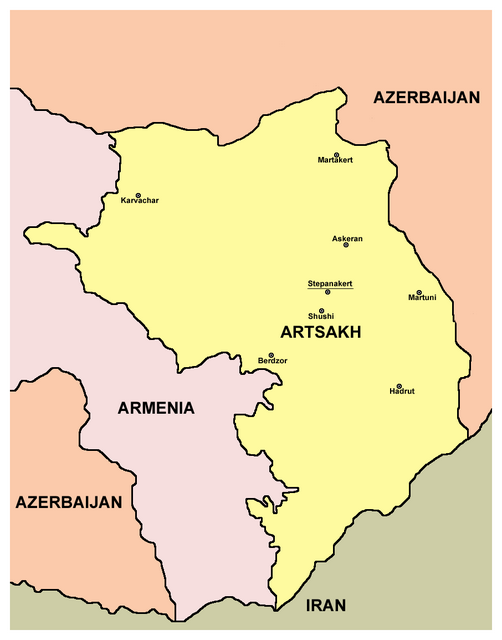
- Stepanakert. (Khankendi) — the capital is a small city and your likely base for exploring the region
- Berdzor. (Lachin) — the first town you pass through upon entering Karabakh. Shops, church and a clinic. There is also a small geological museum and art gallery worth visiting. Admission is free.
- Hadrut. — a small southern town with several nearby 13th- and 14th-century monasteries, and the terminus of the Janapar Trail.
- Karvachar. — administrative center of the Karvachar/Shahumyan region. Nicely sited very small town.
- Martakert. (Aghdara) — administrative center of Martakert Province with the Sarsang Reservoir
- Martuni. (Khojavend) — a small town near the small historically important Amaras Monastery
- Shushi. (Shusha) — the historic capital of Karabakh and formerly one of the cultural capitals of the Caucasus; has lots to see, although the town is largely in ruins from the war and is a shell of its former self
Stepanakert. (Khankendi) — the capital is a small city and your likely base for exploring the region
Berdzor. (Lachin) — the first town you pass through upon entering Karabakh. Shops, church and a clinic. There is also a small geological museum and art gallery worth visiting. Admission is free.
Hadrut. — a small southern town with several nearby 13th- and 14th-century monasteries, and the terminus of the [[Janapar Trail]].
Karvachar. — administrative center of the Karvachar/Shahumyan region. Nicely sited very small town.
Martakert. (Aghdara) — administrative center of Martakert Province with the Sarsang Reservoir
Martuni. (Khojavend) — a small town near the small historically important Amaras Monastery
Shushi. (Shusha) — the historic capital of Karabakh and formerly one of the cultural capitals of the [[Caucasus]]; has lots to see, although the town is largely in ruins from the war and is a shell of its former self
- Agdam. — a huge modern-day ghost town
- Vank. - small town close to the monastery of Gandzasar, one of Karabakh's top attractions. Also known for a hotel in the shape of a boat with a zoo, and the wall of license plates.
Agdam. — a huge modern-day ghost town
Vank. - small town close to the monastery of Gandzasar, one of Karabakh's top attractions. Also known for a hotel in the shape of a boat with a zoo, and the wall of license plates.
Nagorno-Karabakh has been in an indefinite state of political limbo since the 1994 ceasefire of a war in which it became independent. Under the ceasefire agreement, Azerbaijan's government has no control of the region. It remains recognized as part of Azerbaijan by all UN member states, and has been recognized only by three other self-proclaimed and unrecognized states, Transnistria, Abkhazia, and South Ossetia. Although Armenia supports Nagorno-Karabakh economically and militarily, they have not recognized the region's independence.
This region has long been populated by Armenians and it has historically and culturally been part of Armenia. The Soviets, insensitive to such cultural distinctions, included it as an autonomous region of their Azerbaijan republic and so sowed the seeds of the current unrest. As Soviet dominion withered, the Armenians sought to incorporate the region into their newly independent country. This led to a war of independence, similar to those in Transnistria and in other ethnically mixed areas on the former Soviet empire's fringe.
The fighting stopped with the 1994 ceasefire and the dispute moved from the theatre of war to diplomatic circles (the OSCE Minsk Group), where the region is still squabbled over by Armenia and its Russian backers, and Azerbaijan and its Turkish allies.
During the conflict, the Azeri population fled. The region is culturally a part of Armenia. However there is a distinct border complete with immigration formalities on the road from Armenia. Investment and development in the region has invariably come from Armenians, further entrenching Armenian cultural ties.
Nagorno-Karabakh is a landlocked region in the South Caucasus, lying between Lower Karabakh and Zangezur and covering the southeastern range of the Lesser Caucasus mountains. It is mostly mountainous and forested and has an area of 8,223 km2 (3,175 mi2).
Armenian and Russian are widely used. Karabakh Armenians speak a dialect of Eastern Armenian that differs substantially from the Armenian spoken in Yerevan - though most Karabakh Armenians can speak the Yerevan dialect if necessary, and all can understand it. Most older Karabakhtsis can speak Azeri but it is no longer used and is becoming forgotten. Relatively few locals speaks English (though those working in tourist-related areas, i.e. hotels and restaurants, often do speak a reasonable bit of English or at least can find someone around who speaks the language).
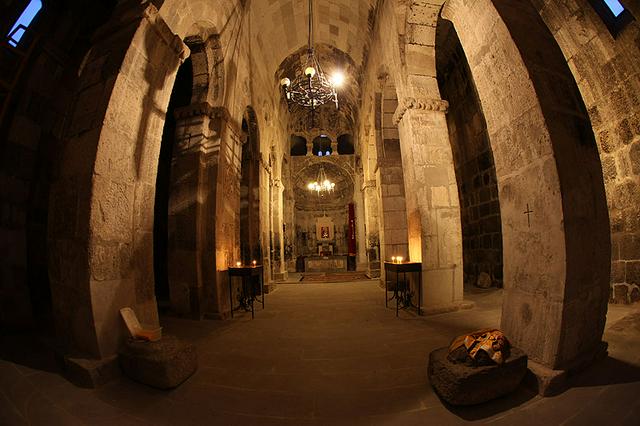
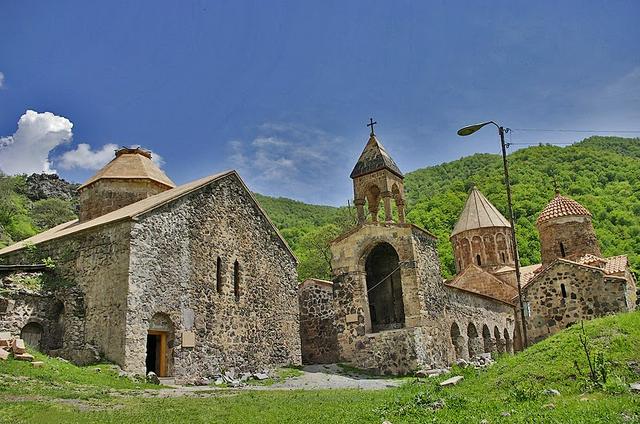
Valuable information about tourist sites is given at the website of Karabakh's travel organisation.
Important tourist attractions inside of the main two cities include:
- Stepanakert, the capital city
- Shuka (Farmers market)
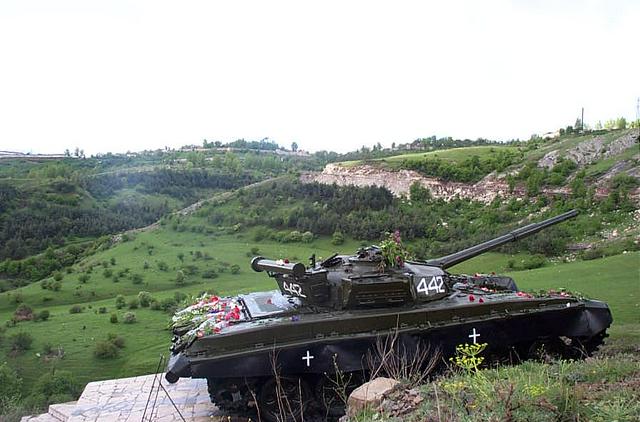
- Tatik Papik aka We Are Our Mountains (famous monument on northern outskirts)
- Shushi
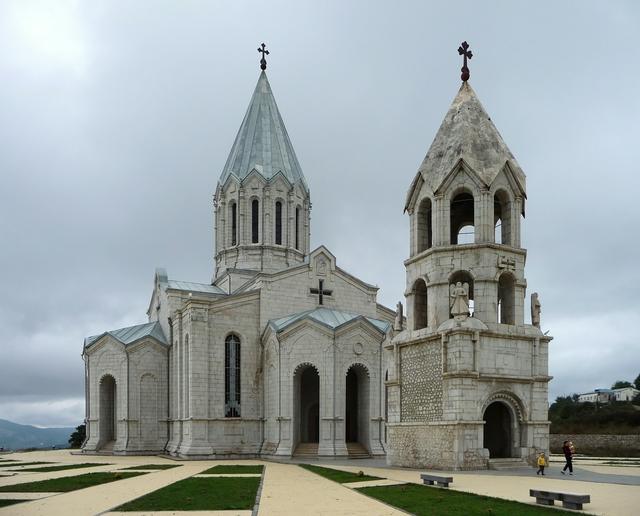
- Ghazanchetsots Cathedral of the Holy Savior
- City walls
- Govharagha Mosque
- Jtrtuz overlook of Karkar Canyon
- Zontik Waterfall (1½-hour hike on Janapar Trail)
Furthermore, many monasteries and other attractions can be found:
- Gandzasar monastery. A main tourist attraction, literally meaning "treasure mountain". Several bust motifs (possibly the donors of the monasteries) can be found at the monastery.
- Dadivank monastery. Like at Gandzasar, bust motifs (possibly the donors of the monasteries) can be found here.
- Gtichavank monastery.
- Amaras monastery.
- Tzitzernavank monastery.
- St. Yeghish Arakyal monastery.
- Yeritsmankants monastery.
- Tigranakert of Artsakh. The ancient city of Tigranakert, one of four cities that were founded in the 1st century BCE in opposite corners of Armenia and named after King Tigran II the Great, ruler of the short-lived Armenian Empire. Tigranakert, which has been undegoing archaeological excavations since 2005, is located in Mardakert District.
- Askeran fortress. 10th–18th centuries. Served as the primary bulwark against Turko-nomadic incursions from the eastern steppe. The fort is found to the northeast of the region's capital city of Stepanakert in Askeran.
Gandzasar monastery. A main tourist attraction, literally meaning "treasure mountain". Several bust motifs (possibly the donors of the monasteries) can be found at the monastery.
Dadivank monastery. Like at Gandzasar, bust motifs (possibly the donors of the monasteries) can be found here.
Gtichavank monastery.
Amaras monastery.
Tzitzernavank monastery.
St. Yeghish Arakyal monastery.
Yeritsmankants monastery.
Tigranakert of Artsakh. The ancient city of Tigranakert, one of four cities that were founded in the 1st century BCE in opposite corners of Armenia and named after King Tigran II the Great, ruler of the short-lived Armenian Empire. Tigranakert, which has been undegoing archaeological excavations since 2005, is located in Mardakert District.
Askeran fortress. 10th–18th centuries. Served as the primary bulwark against Turko-nomadic incursions from the eastern steppe. The fort is found to the northeast of the region's capital city of Stepanakert in Askeran.
- The website of Karabakh's travel organisation has all major events in the country is listed.
- Janapar Trail. One way to see much of Karabakh is simply to walk from one end to the other on the Janapar. There is a marked trail which is broken up into day hikes which extend for 2 weeks of hiking. There are side trails and alternative routes as well. Trails take you to ancient monasteries and fortresses, through forests and valleys, to hot springs and villages. Each night you can either stay with a village family or camp out.
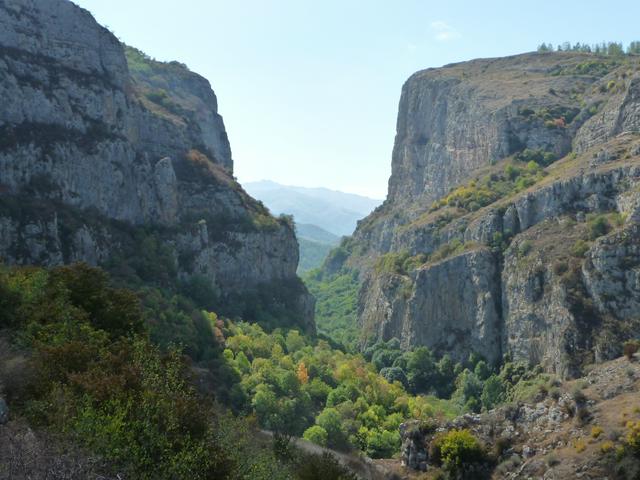
- Qamışlı Gorge. A beautiful and impressively deep and steep gorge created by the river and possibly work for the road leading up north to Qamışlı village. No Azeri sniper will ever be able to aim at cars on this road.
Janapar Trail. One way to see much of Karabakh is simply to walk from one end to the other on the Janapar. There is a marked trail which is broken up into day hikes which extend for 2 weeks of hiking. There are side trails and alternative routes as well. Trails take you to ancient monasteries and fortresses, through forests and valleys, to [[hot springs]] and villages. Each night you can either stay with a village family or camp out.
Qamışlı Gorge. A beautiful and impressively deep and steep gorge created by the river and possibly work for the road leading up north to Qamışlı village. No Azeri sniper will ever be able to aim at cars on this road.
Nagorno-Karabakh uses the Armenian dram (֏ or AMD) for most transactions. The state bank has also issued limited amounts of another currency, Nagorno-Karabakh drams (no symbol or ISO code). The NK dram is available in 2 & 10 dram banknotes and 50 luma (0.5 dram), 1 dram, & 5 dram coins. All banknotes & coins are dated 2004. NK drams are increasingly less common, since they were printed in limited quantities, aren't worth much, and many note & coins have been taken out of the region as souvenirs or to sell to collectors. U.S. dollars & Russian rubles are accepted by some merchants, hotels and others.
The ATMs of the Karabakh's own bank named Artsakhbank do not accept Visa or Mastercards. All other banks accept them.
There are several tourist/souvenir shops in Stepanakert. The area is known for rugs, which make good souvenirs, and it is said that many people in the region and bordering countries learned rug making from the ancient Armenians of Karabakh.
The Tumi village is famous for two elder men who make custom traditional leather shoes. You won't find any other place that makes them. The oldest style of shoes you can find in Armenia.
- Jingalov Hats — a bread that has greens baked into it, a local specialty.
- Tutti Chamich — mulberry raisins, available at the market (shuka)
Many Mulberry trees are to be found, but make sure to eat only ripe fruit - a dark black/red or a pure white. They should not have any green, and should be plump and sweet.
Tutti Oghi — Mulberry Vodka, which Karabakh is famous for, often reaching 80% alcohol, and with a distinct taste.
The Shekher Winery produces a good quality wine.
Western governments advise their citizens to avoid the region but in spite of that, hundreds of westerners visit Nagorno-Karabakh every year.
Don't venture east of the Mardakert-Martuni highway, where the ceasefire line is located. Otherwise, it is very safe to travel around and interact with people. When you first arrive in Karabakh, you must go to what is called the "MIT", the Stepanakert foreign affairs office, to get your travel papers. This will prevent any confusion if one gets pulled over or stopped by local authorities.
If you are planning to hike, be in rural areas, or stay on the outskirts of cities note that the area is inhabited by bears and wolves. While they will not attack if unprovoked, practice bear safety and walk away slowly if unexpectedly approached. If you are planning to hike, the Janapar Trail has been broken into day-long hikes and it is best to take advantage of the homestays offered rather than to camp alongside the trails. If you do camp, make sure to keep your food high in a tree and a few dozen meters (a hundred feet or so) from your tent and do not simply sleep on the ground or in a sleeping bag. Sleep inside a tent.
While the region is fairly safe in terms of crime, you must not lose your passport. There are no foreign embassies in the Nagorno-Karabakh, and you may have a hard time leaving Nagorno-Karabakh without a passport or visa. The US embassy in Baku says that "because of the existing state of hostilities, consular services are not available to Americans in Nagorno-Karabakh." It would be safe to assume that this applies to all other nationalities and their embassies in Baku.
Drink bottled water if you are not accustomed to the local water. However if you are hiking, drinking water in mountain streams and ponds in reasonably safe, as long as you are sure it is not downstream from a large town (in which case it is likely contaminated with chemicals, street runoff, and/or waste.
This is a rural region: in the event of a medical emergency the hospitals in Nagorno-Karabakh are no more than a modest clinic. The nearest major hospital is in Yerevan, a long distance in the event of a heart attack or complications with any medical problems you may have. It is best to have with you a small first aid kit with bandaids, bandages, anti-biotic cream, ibuprofen, and any other medicine you may need.
 The people of Nagorno-Karabakh are very friendly and inviting, and if your Armenian or Russian is good enough, you will easily meet people who will invite you to their house for dinner (and some will even harass you until you accept). Unlike many parts of the world, you should not worry about your safety, no matter how much they harass you, and accept their invitation. Even though these people do not have much and, like many persons in developing countries, view westerners as rich, they will vehemently refuse any type of money given to them (although you may find luck saying it is "for the children"). However, do not show up empty-handed! You will be expected to bring some sort of gift, with food (wine, chocolates, coffee, etc.) being best. You should also bring something to show/give them from your home country (postcard, book, photos, etc.) to have a conversation or at least get their interest. You never know, they may likely have family in another place and what you thought was just dinner could turn into inviting you to other family's businesses (discounts), homes (to stay the night), or another meal.
The wiki on the Janapar trail recommends no trace camping and if you bathe, make sure no locals are around (it may be offensive). Just as stated above, you will receive offers of food and rest. Have gifts for such people, but do not offer money.
It is recommended to have a SIM card of the company Vivacell. All other phone operators that are active in this region refuse for political reasons roaming inside Karabakh.
Alternatively get a SIM card from Karabakh's own phone company Karabakh Telecom when you are in Stepanakert. All you need is your passport and 1,200 dram. This includes the cost for the SIM card and 600 dram as initial money in your account. Using mobile Internet is also possible. The Karabakh Telecom's main office in the Vardan Mamikonyan St. 23 in Stepanakert has personnel speaking English. They can also help you if you have technical problems with your phone.