
Guayaquil is the largest city in Ecuador.
Guayaquil is a sea port, and its personality derives much from that fact. Also, the climate is hot and humid. These two factors give the city a 'Caribbean' soul, where foreigners are usually well received, tropical music rules and seafood is a must do. An old travel book once counted the attractions in Guayaquil as one: "The Public Cemetery". Not so, anymore; the city has undergone a great change as a result of great efforts made by the city administrators. Now you can find great parks and green areas all over the city (for example Peñas and the Malecon), and the city has a new look which attracts tourism from inside and outside the country.
Guayaquil was founded on July 25, 1538 with the name "Muy Noble y Muy Ciudad de Santiago de Guayaquil" by Spanish Conquistador Francisco de Orellana. Before the city was founded by the Spanish, it was a native village.
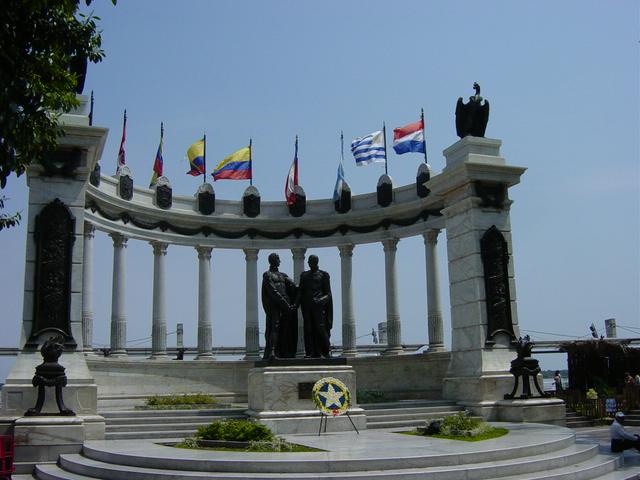 In 1600 Guayaquil had a population of about 2,000 people; by 1700 the city had a population of over 10,000.
In 1687, Guayaquil was attacked and looted by English and French pirates under the command of George d'Hout (English) and Picard and Groniet (Frenchmen). Of the more than 260 pirates, 35 died and 46 were wounded; 75 defenders of the city died and more than 100 were wounded. The pirates took local women as concubines. Quito paid the ransom demanded by the pirates with the condition they release the hostages and not burn Guayaquil.
In 1709, the English captains Woodes Rogers, Etienne Courtney, and William Dampier and 110 other pirates looted Guayaquil and demanded ransom; however, they suddenly departed without collecting the ransom after an epidemic of yellow fever broke out.
In October 9, 1820, almost without bloodshed, a group of civilians supported by soldiers from the "Granaderos de Reserva", a battalion quartered in Guayaquil, overwhelmed the resistance of the Royalist guards and arrested the Spanish authorities. Guayaquil declared independence from Spain, becoming the "Provincia Libre de Guayaquil". Today Guayaquil is the main port and financial center of Ecuador.
These places are located in the downtown area, near the main hotels and at the heart of the regenerated area, a very secure walk.
- The Malecon Simón Bolivar. It is a long park beside the Rio Guayas ("Guayas River"), with shops, an IMAX theater, gardens, and a beautiful view of the river and downtown.
- The "Malecon del Salado" is next to the "Estero Salado" (an estuary of sea water). Here you can enjoy fresh air and wonderful sunsets, with restaurants of local food, in a very safe park.
- The renewed downtown area (Area regenerada), very secure to walk and look around.
- Museums (Museo Municipal, Museo Nahim Isaias, MAAC and Presley Northon Museum are located in the center of the downtown)
- Santa Ana & El Carmen hills. You can see almost the whole city from here. You can walk up the 400-odd steps to the top from the Malecon Simón Bolivar. There is a lighthouse, museum, small chapel and park at the top. Along the stairs, vendors sell water, ice cream and other snacks.
- Las Peñas, where the city was founded, has been rebuilt and painted bright colors where most of Guayaquil's colonial buildings are.
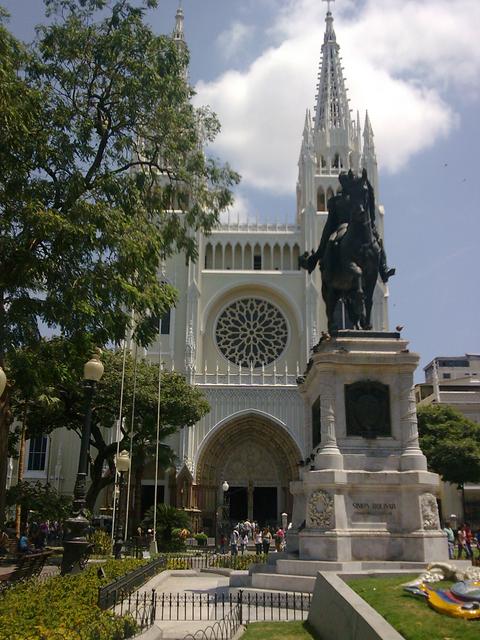
- Parks. Visit the "Parque de las Iguanas" downtown, which is home to hundreds of tame iguanas, some fish in a pond, a black squirrel or two, and some turtles.
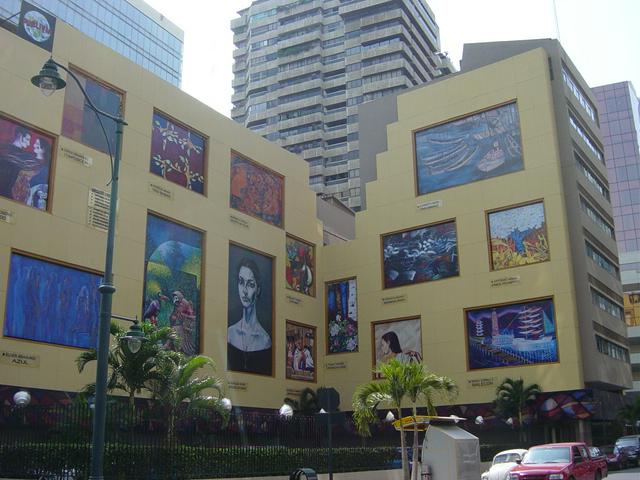
- The Central Bank Building has several giant paintings on the outside of the building.
- Markets. You can visit the "Mercado Artesanal", where you can buy some very cheap souvenirs from all regions of Ecuador. Near the Malecon Simón Bolivar.
- The cemetery north from the centre has a few impressive graves and statues and plenty of more normal graves. Worth a visit if you're into graveyards.
Other interesting places near Guayaquil:
- "Parque Histórico", an interesting recreation of the early 20th century years of Guayaquil, the look, the people and the food. Includes a small zoo.
- "Crucero Discovery", rides up and down the Rio Guayas. You can catch it at Malecon Simón Bolivar. Crazy parties at night.
- Traditionally, Salinas has been the main beach, but since 2008 General Villamil Playas has attracted a big part of the local and international tourism. Fishing, surfing, and other water sports. Many modern hotels and delicious sea food. Interesting night life. Wonderful whalewatching during June to September.
The following places are interesting to see if you are daring:
- 6 de Marzo is an interesting street to visit about 10 blocks from the downtown area during the week before New Year's Eve, because the street is lined with "Años Viejos" or old years, papier-mâché figures ranging in size from about 30 cm (12 in) up to 3 m (10 feet) tall. These are often political, movie or cartoon characters.
- La Bahía, just off the southern end of the Malecon Simón Bolivar. Huge market area full of shops and stalls of almost anything imaginable. Because it is so cheap you will have lower social class people and have to be a little careful with belongings.
- Cocoa or banana plantations are located around Guayaquil city.
The "Malecon del Salado" is next to the "Estero Salado" (an estuary of sea water). Here you can enjoy fresh air and wonderful sunsets, with restaurants of local food, in a very safe park.
Santa Ana & El Carmen hills. You can see almost the whole city from here. You can walk up the 400-odd steps to the top from the Malecon Simón Bolivar. There is a lighthouse, museum, small chapel and park at the top. Along the stairs, vendors sell water, ice cream and other snacks.
Las Peñas, where the city was founded, has been rebuilt and painted bright colors where most of Guayaquil's colonial buildings are.
The Central Bank Building has several giant paintings on the outside of the building.
Markets. You can visit the "Mercado Artesanal", where you can buy some very cheap souvenirs from all regions of Ecuador. Near the Malecon Simón Bolivar.
"Parque Histórico", an interesting recreation of the early 20th century years of Guayaquil, the look, the people and the food. Includes a small zoo.
"Crucero Discovery", rides up and down the Rio Guayas. You can catch it at Malecon Simón Bolivar. Crazy parties at night.
Traditionally, Salinas has been the main beach, but since 2008 General Villamil Playas has attracted a big part of the local and international tourism. Fishing, surfing, and other water sports. Many modern hotels and delicious sea food. Interesting night life. Wonderful whalewatching during June to September.
La Bahía, just off the southern end of the Malecon Simón Bolivar. Huge market area full of shops and stalls of almost anything imaginable. Because it is so cheap you will have lower social class people and have to be a little careful with belongings.
There are about 20 malls in the city. A nice place to buy is Via Samborondon.
- Mall del Sol
- Mall del Sur
- Riocentro Norte
- City Mall
- Riocentro Los Ceibos
- Riocentro Sur
- Riocentro Entreríos
- San Marino
- Alban Borja
- Garzocentro
- Policentro
- Village Plaza, near Riocentro Entreríos.
Besides that, there are several popular spots like:
- Mercados Artesanal
- La Bahia
- There are many traditional dishes to try, such as encebollado, seco de pollo, ceviche, and caldo de salchicha.
- There are also many international fast food chains throughout the city such as Burger King, Wendy's, KFC, McDonald's, Taco Bell and Pollo Tropical.
- Parrillada del Ñato; foods such pizza, grilled meat, and more are served.
- Red Crab. Coastal food: fish, crabs, shrimp; a big variety of dishes and combinations. A little pricey for the medium. Has two locations: 1. in Urdesa: Av. V.E.Estrada 1205 y Laureles. 2. in Samborondón: Plaza Nova, Km. 2,5 vía a Samborondón.
- Chinese restaurants (Chifas) are found throughout the city, and their food is very good.
- 'El Patacón' restaurant in Urdesa serves local cuisine, mostly based on verde (green bananas also known as 'Plátano Macho' in Central America).
- Vegetarian food is not very common in Guayaquil, but there is a guesthouse in the Centro called Manso that serves quinoa and lentil hamburgers and other dishes that combine Ecuadorian ingredients in fast food format for veggies.
- There is a lot of great cuisine in Guayaquil's centre. If you are more daring, you can go to this downtown area, near 9 de octubre avenue; there are Chinese restaurants called "chifas" and local restaurants where you can eat the seco de pollo, caldo de salchicha, etc.
- A myriad of more upscale shopping opportunities and bars can be explored around the Urdesa neighborhood, especially along its main drag, Victor Emilio Estrada. Wonderful small food carts are scattered throughout, called "Carretillas". Common on the streets, those with "Shawarma" (the Lebanese gyro) are particularly delicious. These abound, due to a large expatriate Lebanese community which has been a part of Guayaquil for almost a century.
- Lo Nuestro has a good variety of traditional dishes.
- You can also go to a restaurant where the best 'encebollado' is sold. The place is called "Encebollado cordero"; it is near the IESS.
Lo Nuestro has a good variety of traditional dishes.
- Samborondon is in the northeast of the city. There are a lot of restaurants with a great variety of food. Here you can find Japanese, Italian, American, and local food, too.
- Taberna Libanesa is an excellent place, located just behind the Supermaxi, Via Samborondon. Cozy and elegant, with excellent Lebanese food. They serve lunch and dinner and have a few tables on the veranda of this upscale shopping center.
- Urdesa. In the Victor Emilio Estrada you can found a great variety of good food and also a nice place to visit.
Samborondon is in the northeast of the city. There are a lot of restaurants with a great variety of food. Here you can find Japanese, Italian, American, and local food, too.
Taberna Libanesa is an excellent place, located just behind the Supermaxi, Via Samborondon. Cozy and elegant, with excellent Lebanese food. They serve lunch and dinner and have a few tables on the veranda of this upscale shopping center.
Urdesa. In the Victor Emilio Estrada you can found a great variety of good food and also a nice place to visit.
Red Crab. Coastal food: fish, crabs, shrimp; a big variety of dishes and combinations. A little pricey for the medium. Has two locations: 1. in Urdesa: Av. V.E.Estrada 1205 y Laureles. 2. in Samborondón: Plaza Nova, Km. 2,5 vía a Samborondón.
Great nightlife; you can go to 5 or more discos in one night, and don't need to travel much. The usual price for entering is $10-$15 consumable, depending on where you go.
Usually the parties there last to 04:00. but you can always find something else to do in this city. Visit the "Zona Rosa", located at the secure regenerated area, with several options of night life. Several brands of beer are available.
- El Gran Yate, Alborada (close to Dreamkapture. Crabs and beers, $1 a crab
- Bloom Club, Aventura Plaza Local 46 (Av. Las Monjas, Urdesa, +593 9 931 5800. Th-Sa at 20:00 - 04:00. It is a mid-size club for 200 people approx. offering a broad selection of music and drinks, very popular among people from 20 to 40 years old. The Shopping Center "Aventura Plaza" offers security and has a nice park inside, with a huge iguana sculpture on it; it features other sport and karaoke bars, small discos and some good restaurants as well, at affordable prices. A parking lot is available at no cost but if you plan to drink, taking a cab is better, and at your departure it is recommended to ask the host to get you a secure taxi. The entrance fee is $20 consumable but if you are an international traveller you can enter for free and pay as you drink showing your passport or international ID. The costs ranges from $3 to $5 a beer, and $6 to $10 a glass of rum, vodka, whiskey or a cocktail, or a bottle starting from $75.
El Gran Yate, Alborada (close to Dreamkapture. Crabs and beers, $1 a crab
Bloom Club, Aventura Plaza Local 46 (Av. Las Monjas, Urdesa, +593 9 931 5800. Th-Sa at 20:00 - 04:00. It is a mid-size club for 200 people approx. offering a broad selection of music and drinks, very popular among people from 20 to 40 years old. The Shopping Center "Aventura Plaza" offers security and has a nice park inside, with a huge iguana sculpture on it; it features other sport and karaoke bars, small discos and some good restaurants as well, at affordable prices. A parking lot is available at no cost but if you plan to drink, taking a cab is better, and at your departure it is recommended to ask the host to get you a secure taxi. The entrance fee is $20 consumable but if you are an international traveller you can enter for free and pay as you drink showing your passport or international ID. The costs ranges from $3 to $5 a beer, and $6 to $10 a glass of rum, vodka, whiskey or a cocktail, or a bottle starting from $75.
There are cyber cafes around to communicate with distant friends and relatives. These often have telephone booths for making VoIP phone calls. Some malls (Mall del Sol, Riocentro Los Ceibos) even offer free Wi-Fi in the food courts, in addition to free entertainment. Buy $30 worth of groceries at Mi Comisariato and get a two for one coupon to the movies.
Guayaquil is considered to be a dangerous place as of 2018. There is violent crime, and women travellers should be particularly careful. The port area and south Guayaquil are especially dangerous. Be aware in Plaza Centenario, especially when it is very crowded.
The U.S. Department of State warned in 2018 that:
"Visitors should exercise extreme caution in the downtown area and the southern part of Guayaquil. Tourist sites -- the Christ statue (Sagrado Corazon de Jesus) on Cerro del Carmen, the Malecon 2000, and Las Peñas -- though well-patrolled by police, are targeted by criminals hoping to prey on unsuspecting tourists. There have also been reports of armed robberies at restaurants in the Urdesa and Samborondon areas."
Always remain aware of your surroundings. Don't pay attention to anyone trying to speak to you on the streets, not even to wealthy-looking people or beggars. Avoid walking alone around the downtown area at night, especially off Avenue 9 de Octubre or well-lit areas. Don't flash money or valuable things in public. Never walk in suspicious areas. Guayaquil is especially dangerous at night, so avoid walking on streets at night.
Attacks have been reported where someone will distract the target so that the attacker can put a choke hold on the victim from behind and make the victim pass out in order to easily rob the person.
Use only official taxis, and radio taxis instead of hailing one off the street, as there have been many cases of robberies involving taxi cabs. Avoid wearing jewelry that is expensive or appears to be of high quality.
The only drinkable water is bottled water.
Several countries have consulates in Guayaquil such as:
- United States
- Germany
- Greece
- The Netherlands
- Syria
- Switzerland
- Japan
- Colombia
- United Kingdom
- Israel
- Mexico: Pedro Carbo No. 555 y Vélez. +593 4 232-0964, 232-8114, 232-8117.
Other places that you can visit are the beaches at Playas which is about 90 minutes away, and the more popular Salinas beach which is about two hours away up the Via la Costa.
Quito is about a 7-hour drive (less than an hour flight also for about $125 round trip, September 2009)
Cuenca is about a four hour drive (half-hour flight for about $120 round trip, September 2009) through beautiful and interesting scenery, including a mangrove preserve, cocoa and banana plantations, cloud forests and mountains.
Not too far out, perhaps 30-50 minutes, there is a beautiful cocoa plantation where they also make chocolate. The owners entertain tour groups by serving cocoa juice and plantain snacks before you are taken on a tour of the cocoa plantation right up to the final chocolate tasting. You are then entertained with a delicious local lunch. Absolutely fabulous! It is past the orchids farm on the same road. The cost is $110 per person when booked via tour operator Canodos. The tour operator is essential if you don't speak Spanish.
There are several bus companies that cross the border to Peru that are available from Guayaquil. Most services stop close to the main cities along the Panamericana motorway; such as Machala, Tumbes, Máncora, Piura and all the way to Lima.
- CIFA: They have a stand inside the main terminal, within the international section. Usually this is the company that provides the cheapest services and a popular choice among backpackers. They have several departure times a day and different services. Procure the direct service that goes to your desired destination, since some services do stop a lot along the way. Their buses might have somewhat low cleaning standards.
- Ormeño: Buses leave daily around 11:00 close to the main bus terminal, where their office is located. Just go to the terminal, ask for the office of Ormeño and walk 5 minutes outside the terminal. Ormeño has been in business for several years. Unfortunately, the buses were never renewed and are known for bad services, so air conditioning might not work. In case one should have problems at the Peruvian border, the bus drivers might not wait until the formalities are done.
- Ecuatoriano Pullman: Departs everyday at 23:00 from the main station, where their stand is also located at the international section.
Nevertheless, other companies like Ruta De America and Caracol can be valuable alternatives. Routa de America goes from Guayaquil to Lima every Sunday. Call their office in Quito for more information.
CIFA: They have a stand inside the main terminal, within the international section. Usually this is the company that provides the cheapest services and a popular choice among backpackers. They have several departure times a day and different services. Procure the direct service that goes to your desired destination, since some services do stop a lot along the way. Their buses might have somewhat low cleaning standards.
Ormeño: Buses leave daily around 11:00 close to the main bus terminal, where their office is located. Just go to the terminal, ask for the office of Ormeño and walk 5 minutes outside the terminal. Ormeño has been in business for several years. Unfortunately, the buses were never renewed and are known for bad services, so air conditioning might not work. In case one should have problems at the Peruvian border, the bus drivers might not wait until the formalities are done.
Ecuatoriano Pullman: Departs everyday at 23:00 from the main station, where their stand is also located at the international section.