
Bosnia and Herzegovina (Bosnian: Bosna i Hercegovina, Босна и Херцеговина, usually shortened to BiH) is a European country located on the Balkan Peninsula. It used to be part of Yugoslavia but gained independence in 1992. Mostly mountainous, it has access to a tiny portion of the Adriatic Sea coastline in the south.
While the nation is divided into two "entities"; the Federation of Bosnia and Herzegovina with a predominant Bosnian/Croatian population and the Republika Srpska (i.e. Serbian Republic/Republic of Serbs or RS) with a Serbian majority population, here is a "traveler-friendly" division of the nation based on traditional regions.
- Sarajevo. — the national capital; a cosmopolitan European city with a unique Eastern twist as can be seen in its vast diversity of architectural styles
- Banja Luka. — the second largest city, serving as the capital of Republika Srpska, with some historical sights and a rich nightlife
- Bihać. — city near Croatian border, surrounded by an impressive nature preserve.
- Jajce. — a small city with a beautiful waterfall and number of historical attractions dotted around its centre
- Mostar. — a nice old town on the Neretva River, symbolised by its medieval bridge
- Neum. — the only coastal town, with sandy beaches backed by steep hills
- Tuzla. — third largest city with much industry, though has a lovely old town and monuments to the brutal war too
- Teslic. — а health spa resort with the biggest tourist capacity in the country
- Zenica. — city with an Ottoman old quarter
Sarajevo. — the national capital; a cosmopolitan European city with a unique Eastern twist as can be seen in its vast diversity of architectural styles
Banja Luka. — the second largest city, serving as the capital of Republika Srpska, with some historical sights and a rich nightlife
Bihać. — city near Croatian border, surrounded by an impressive nature preserve.
Jajce. — a small city with a beautiful waterfall and number of historical attractions dotted around its centre
Mostar. — a nice old town on the Neretva River, symbolised by its medieval bridge
Neum. — the only coastal town, with sandy beaches backed by steep hills
Tuzla. — third largest city with much industry, though has a lovely old town and monuments to the brutal war too
Teslic. — а health spa resort with the biggest tourist capacity in the country
Zenica. — city with an Ottoman old quarter
- Kozara. — national park in the north-west with dense forests and hilly meadows, a hiking and hunting destination.
- Međugorje. — inland town between mountains with a mild Mediterranean climate, but perhaps best known due to claims of apparitions of the Virgin Mary to six locals.
- Srebrenica. — small town in the north-east, beautiful nature (third deepest canyon, of river Drina in the world), best known as the site of a genocide during the Bosnian War.
- Igman. ski resort
- Jahorina. ski resort
- Bjelašnica. ski resort
Kozara. — national park in the north-west with dense forests and hilly meadows, a hiking and hunting destination.
Međugorje. — inland town between mountains with a mild Mediterranean climate, but perhaps best known due to claims of apparitions of the Virgin Mary to six locals.
Srebrenica. — small town in the north-east, beautiful nature (third deepest canyon, of river Drina in the world), best known as the site of a genocide during the Bosnian War.
Igman. ski resort
Jahorina. ski resort
Bjelašnica. ski resort
The idea of a Bosnian nationality is used to mainly apply to the nation's Muslims, also referred to as Bosniaks. Bosnia's Croatians and Serbians looked up to Croatia and Serbia respectively for guidance and as the parent country and both had aspirations for political union with either Croatia or Serbia once the Yugoslavian union began to fall apart in the early 1990s. This of course spelled disaster for the state of Bosnia and Herzegovina, resulting in a bloody civil war fought between all three groups. In the end the Bosnian-Croatian alliance fought the Serbian forces on the ground whilst NATO attacked the Bosnian Serbs from the air, causing a military defeat for the Serbs. A peace treaty followed, with the detailed scrutiny of the US Clinton Administration helping seal the deal. The result was that Bosnia and Herzegovina would be a federation comprising a Bosnian-Croatian unit alongside a Serbian autonomous unit. Things have rapidly improved since then but the two regions of Bosnia and Herzegovina still have a long way to go towards complete political and social union. Bosnia and Herzegovina functions as one country with two or even three different parts. However, the central government lies in Sarajevo and there is one common currency, the convertible mark, sometimes denoted locally as KM a currency named after and pegged one to one to the Deutschemark which was replaced by the euro in 2002 in Germany.
- 9 May 1945
- End of World War II (National Holiday)
- National holiday in Federation of BiH
- 25 November: Bosnia and Herzegovina's declaration of sovereignty in October 1991, was followed by a declaration of independence from the former Yugoslavia on 3 March 1992 after a referendum boycotted by ethnic Serbs. This national holiday is not commemorated in the RS.
- National holiday in Republika Srpska
- 9 January: The Day of the Republic. On 9 January 1992, the Bosnian Serb Assembly adopted a declaration on the Proclamation of the Serbian Republic of Bosnia and Herzegovina. In August 1992, the reference to Bosnia and Herzegovina was dropped from the name, and it became "Republika Srpska".
- Independence
- 1 March 1992 (from Yugoslavia; referendum for independence was completed 1 March 1992; independence was declared 3 March 1992)
The Bosnian Serbs - supported by neighbouring Serbia and Montenegro -responded with armed resistance aimed at partitioning the republic along ethnic lines and joining Serb-held areas together to form a "greater Serbia." In March 1994, Bosniaks and Croatians reduced the number of warring factions from three to two by signing an agreement creating a joint Bosniak-Croatian Federation of Bosnia and Herzegovina. On 21 November 1995, in Dayton, Ohio, the warring parties signed a peace agreement that brought to a halt the three bloody years of ethno-religious civil strife (the final agreement was signed in Paris on 14 December 1995).
- Constitution
- the Dayton Agreement, reached at Wright-Patterson Air Force Base near Dayton, Ohio, United States, on 21 November 1995, and signed in Paris on 14 December 1995, included a new constitution now in force;each of the entities also has its own constitution.
The Dayton Agreement retained Bosnia and Herzegovina's international boundaries and created a joint multi-ethnic and democratic government. This national government was charged with conducting foreign, economic, and fiscal policy. Also recognised was a second tier of government comprised of two entities roughly equal in size: the Bosniak/Croat Federation of Bosnia and Herzegovina and the Bosnian Serb-led Republika Srpska (RS). The Federation and RS governments are charged with overseeing internal functions.
In 1995-96, a NATO-led international peacekeeping force (IFOR) of 60,000 troops served in Bosnia to implement and monitor the military aspects of the agreement. IFOR was succeeded by a smaller, NATO-led Stabilization Force (SFOR) whose mission is to deter renewed hostilities. SFOR was shut down at the end of 2004. Some foreign troops remained until at least 2013.
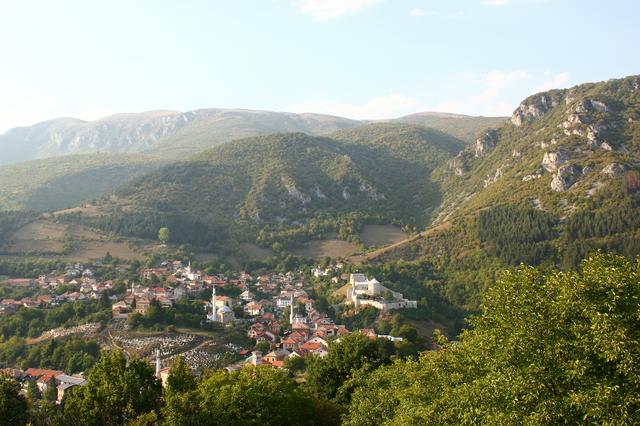 Bosniaks, Croatians and Serbians form the largest ethnic groups in the country. Since the break-up of Yugoslavia, Bosniak has replaced Muslim as an ethnic term in part to avoid confusion with the religious term Muslim — an adherent of Islam. Ethnicity and religion mostly overlap; with Muslims (mostly Bosniaks), Roman Catholic Christians (mostly Croatians) and Orthodox Christians (mostly Serbians) being the three main religious groups of the country. There are also some Roma, Protestants and Jews as well. Nevertheless, the country is highly secular and religion is seen as more of a traditional and cultural identity than a set of rituals and rules.
Hot summers and cold winters; areas of high elevation have short, cool summers and long, severe winters; mild, rainy winters along coast
A succession of mountains with relatively few intervening fertile valleys. There are occasional earthquakes and the highest point is Maglić at 2,386m.
The official languages in Bosnia and Herzegovina are Bosnian, Serbian and Croatian, all three known as Serbo-Croatian as they are practically the same language. Serbo-Croatian is written in both Latin and in Cyrillic, making it the only Slavic language to officially use both scripts. In the Republika Srpska you'll see signs in Cyrillic, so a Serbian-English dictionary would be helpful there.
Variants among the Serbo-Croatian language differ only in the most academic of venues and also in traditional homes. There are different versions of the language throughout the area and spoken language changes between regions. However, the vocabulary differences are only cosmetic and do not hinder communication between Bosnian Muslims, Catholic Croatians and Orthodox Serbs.
Many Bosnians speak English, as well as German owing to family connections as well as tourism in former Yugoslavia before the war. Some older people are also able to speak Russian, as it was taught in schools during the communist era. Other European languages (e.g. French, Italian, Greek) are only spoken by a few educated individuals.
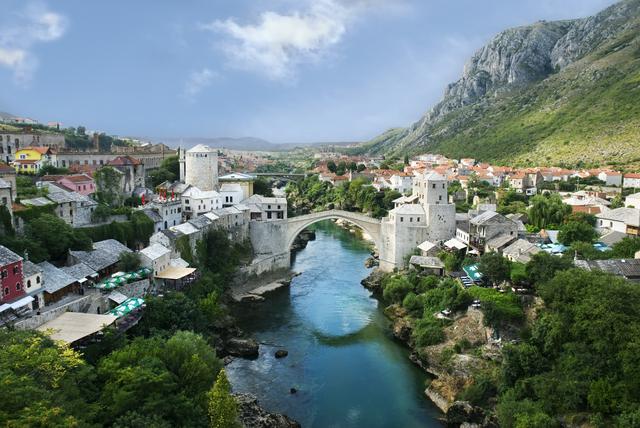
 If Bosnia and Herzegovina makes you think of concrete Communist architecture or 1990s images of war-demolished town centres double-torn by ethno-religious strife, you're in for a pleasant surprise. Of course this country bears the marks of its tumultuous history, but visitors today find rebuilt and well restored historic cities, a warm and welcoming atmosphere, bustling city life and -overall- more medieval monuments than Socialist housing blocks. In fact, some of the remains of the Communist era, like the Tito bunker near Konjic, have become attractions of their own.
The country's main visitor draws however lie in its charming historic town centres, ancient heritage sites and splendid nature. Sarajevo has some of the most extensive Socialist housing projects, but is also a colourful historic mix of East and West, where religions and cultures coexisted for centuries. It's a vibrant town that resurrected into what it always was; the country's modern capital, proud of its heritage and a popular destination for travellers of all kinds. Top sights include the lively Baščaršija or Old Bazaar, the Sarajevo cathedral, the Gazi Husrev-beg's Mosque and of course the legacy sports facilities of the 1984 Olympics. Equally interesting is the Tunel spasa, or tunnel of hope, which brought supplies to the people of Sarajevo in the war and is now a museum. The beautiful old town of Mostar is another city gem, with the famous an Unesco World Heritage listed Stari Most bridge as a main landmark. Carefully rebuilt, it's widely recognised as one of the finest examples of Islamic architecture in the Balkans. Višegrad has a Unesco listed bridge of its own, namely the impressive Mehmed Paša Sokolović Bridge. For more city grandeur, try the green gardens and avenues of Banja Luka. Finally, most components of the world heritage Stećci Medieval Tombstones Graveyards (medieval decorated tombstones) are located in Bosnia and Herzegovina.
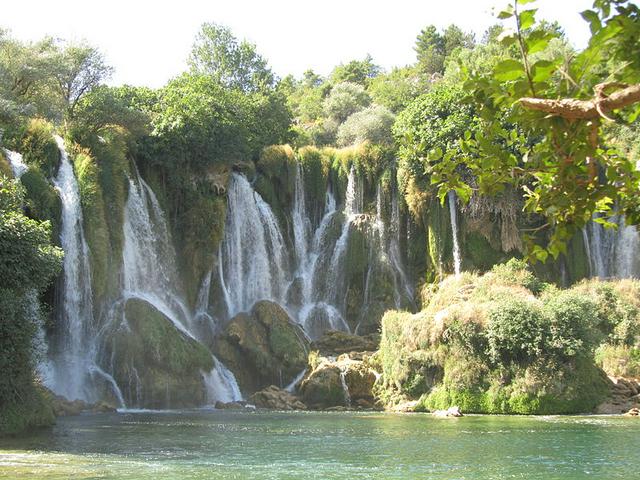
Great natural attractions can be found all around, even close to the main cities. Take a horse carriage to Vrelo Bosne (the spring of river Bosna) to join Sarajevo families for quiet getaways and picknicks. The waterfalls of Kravice, about 40km from Mostar, make for another fabulous natural trip. A popular spot for city dwellers and rafters, the water of the Trebižat River drops some 30 meters in a beautiful natural setting of tuff walls. Other dramatic waterfalls can be found in the far west of the country, in the lush Una National Park. And then of course, there is the famous Jajce waterfall, where the clear waters of the Pliva river drop 17 meters right in the middle of the town. Nature lovers may also want to include Hutovo Blato Natural Park for bird watching or Sutjeska National Park, with a waterfall as well as one of only two remaining primeval forests in Europe.
Top picks for village life can be found in the historic citadel of Počitelj, Blagaj (where you'll also find the spring of the river Buna) or, for environmentalists, in the Zelenkovac ecovillage near Mrkonjić Grad. Just outside of Radimlja is the largest collection of Stećak, a remarkable kind of pre-Ottoman tombstones that are found throughout the ancient Bosnian Kingdom.
Rafting on the Neretva river, the Una river and the Tara with the Drina river, with some shorter courses on the Krivaja river, the Vrbas river and the Sana river.
2009 World championship of rafting was held in Banja Luka on the Vrbas river and in Foča on the Drina, both in RS.
The Neretva river and its tributary the Trebižat, the Unac river, also the Krivaja river and its tributary Bioštica river are great kayaking destinations with a lot of whitewater on the Krivaja river. The Pliva river and its lakes Veliko and Malo are great canoeing destinations, also the middle and lower Una river, the Trebižat river.
The famous Rakitnica canyon of the Rakitnica river, tributary of the Neretva river, offer great canyoning adventure, but even extreme canyoning route can be found in the Bjela river another tributary of the Neretva river. The Unac river and its canyon offer great canyoning route.
Also close to Banja Luka you can explore the canyons of the Svrakava and Cvrcka rivers.
Sport is popular in the country, while mountainous terrain of the country getting increasingly popular destination for bikers from all over the world.
-ypGQj.medium.jpg) Bosnia and Herzegovina was the 1984 host for the Winter Olympics, and it still takes pride of its winter sports potential. Especially around Sarajevo there are challenging venues. During the war of the 1990s many Olympic venues were severely affected, but at present all is put in place to give the skier a great experience.
Bosnia and Herzegovina was the 1984 host for the Winter Olympics, and it still takes pride of its winter sports potential. Especially around Sarajevo there are challenging venues. During the war of the 1990s many Olympic venues were severely affected, but at present all is put in place to give the skier a great experience.
Close to Sarajevo there are the Bjelasnica, with over 8 km of ski trails, the Jahorina (20 km) and Igman mountains. Close to Travnik is the Vlasic Mountain with 14 km. Other resorts are Blidinje, Vlasenica in the east and Kupres in Western Bosnia.
Bjelašnica and Jahorina are also beautiful for hikes during summer.
Hiking is great in the unspoiled nature of BiH. A good guidebook is Forgotten beauty : a hiker's guide to Bosnia and Herzegovina's 2000 metre peaks - and other selected adventures by Matias Gomez.
The most fly-fishing areas in Bosnia are in the North-West of the Bosanska Krajina, within National Park "Una", and around the river Sana . Fly-fishing fanatics can go on a tour by the different trout-hotspots on the river Una, the Klokot, the Krušnica, the Unac, the Sana, the Bliha, the Sanica, the Ribnik, the Vrbas, the Pliva, the Janj, the Sturba, the Trebižat, the Buna, the Bunica, the Neretva, the Tara, the Sutjeska, the Drina, the Fojnica, the Bioštica, the Žepa, and many other smaller rivers and streams; most famous centres are Konjic, Glavatičevo, Tjentište within National Park "Sutjeska", Foča, Goražde, Bosanska Krupa, Bihać, Martin Brod, Drvar, Ribnik, Ključ, Sanica, Sanski Most, Šipovo, Jajce, Livno, Blagaj. In several of those towns there are resorts specially geared towards the needs of the angler.
The official currency is the konvertibilna marka (or marka) (convertible mark), denoted by the symbol "KM" (ISO code: BAM). It is fixed to the euro at the precise rate of 1.95583 for €1.
There are two sets of banknotes, with distinct designs for the Federation and the Republic of Srpska. However, both sets are valid anywhere in the country.
Before you leave the country, be sure to convert back any unused currency into something more common (euros, dollars) as most other countries will not exchange this country's "convertible marks".
Credit cards are not widely accepted - ATMs are available in the most cities (Visa and Maestro). Try to not pay with KM100 bills, as smaller shops might not have enough change.
Most towns and cities will have markets and fares where any number of artisans, sellers, and dealers will offer any kind of stock. Different foods are readily available, both fresh and cooked, as well as clothing, jewellery and souvenirs. At the markets you are able to negotiate with the seller, although that may take some practice. Like in most such venues prices may be inflated for foreigners based on a quick 'means test' made by the seller. Often those who look like they can afford more will be asked to pay more.
You'll find large shopping centres in most cities and towns.
Sarajevo is fine for buying clothes and shoes of cheap quality at a relatively affordable price. The main shopping streets of Sarajevo are also great for black market products including the latest DVDs, video games and music CDs. Most tourists who visit Sarajevo no doubt leave with a few DVDs to take back home.
Visoko and the central Bosnia region are very well known for their leather work.
Banja Luka has seven big shopping malls, as well many small businesses, and you will be able to find a large variety of goods.
Mostar has an excellent shopping mall on the Croatian side with some typical European-style clothing boutiques and jewellery shops.
If you have a temporal (tourist) residency status and you buy goods worth more than KM100 you are entitled to a PDV (VAT) tax refund. PDV consist of 17% of the purchase price. The refund applies to all goods bought within three months before leaving, except petroleum, alcohol or tobacco. At the shop, ask the staff for a tax-refund form (PDV-SL-2). Have it filled out and have stamped (you need your identity card/passport). Upon leaving BiH, the Bosnian customs can verify (stamp) the form if you show them the goods you bought. A PDV refund in Marks can be obtained within three months, either at the same shop where you bought the goods (in that case the tax will be refunded to you immediately), or by posting the verified receipt back to the shop, together with the account number into which the refund should be paid.
Be aware that upon entering another country you might be obliged to pay VAT over the goods exported from Bosnia. But there is always a free amount, mostly a few hundred euros; EU: €430. Also, the procedure at the border might take a bit of time, so it is not wise to try this when travelling by train or bus, unless the driver agrees to wait.
-kqVSf.medium.JPG) The most available food in Sarajevo is Cevapi (normally 2-4 km), the ubiquitous Balkan kebab. Two prominent variations exist - the "Banja Luka" Cevap, a larger kebab with a square shape, and the Sarajevo Cevap, smaller and round. If you have not had them before, every visitor should try an order of Cevapi at least once. There are several variations of pita (around 2 km). A cheap, tasty and readily available snack is "Burek", a pastry made of filo dough and stuffed with meat (simply Burek), cheese (Sirnica), spinach (Zeljanica), potatoes (Krompirusa) or apple (Jabukovaca). Some examples are better than others, however, and it can be a greasy affair. If you get to Mostar, however, try to grab a plate of trout ("pastrmka," which sounds like "pastrami"), which is the local specialty (a particularly fine restaurant serving locally farmed trout lies by the wonderful Blagaj monastery, a short bus ride from Mostar).
The most available food in Sarajevo is Cevapi (normally 2-4 km), the ubiquitous Balkan kebab. Two prominent variations exist - the "Banja Luka" Cevap, a larger kebab with a square shape, and the Sarajevo Cevap, smaller and round. If you have not had them before, every visitor should try an order of Cevapi at least once. There are several variations of pita (around 2 km). A cheap, tasty and readily available snack is "Burek", a pastry made of filo dough and stuffed with meat (simply Burek), cheese (Sirnica), spinach (Zeljanica), potatoes (Krompirusa) or apple (Jabukovaca). Some examples are better than others, however, and it can be a greasy affair. If you get to Mostar, however, try to grab a plate of trout ("pastrmka," which sounds like "pastrami"), which is the local specialty (a particularly fine restaurant serving locally farmed trout lies by the wonderful Blagaj monastery, a short bus ride from Mostar).
Local food is heavy on meat and fish, and light on vegetarian alternatives. Even traditional so-called vegetarian dishes like beans or Grah are cooked with bacon or smoked meats. Stews often contain meat but can be created without it. Rice and pasta dishes are readily available and a traditional sourdough soup filling called Trahana is hand made in most regions and a staple during the fasting month of Ramadan. Fast food, with the exceptions of cevapi and pita (or burek) consists of, like in other parts of Europe, pizza, hamburgers and hot dogs. Panini sandwiches are served in most coffee shops popular with the youth, and Bosnian coffee, reminiscent of Turkish coffee, is a must-try for any coffee aficionado. Oddly, apart from these fast food options, Bosnian restaurants serve few Bosnian specialities - what people eat in their homes is very different from what they will eat if they go to a restaurant.
-OacEw.medium.jpg) All along Bosnian roads and recreational places, you will notice advertisements for janjetina or "lamb on a spit." This is a very tasty treat, usually reserved for special occasions. A whole lamb is cooked on a spit, by rotating over a coal fire for a long time. When you order, you pay by the kilogram, which costs around KM25 (not bad since this is enough for several people). On special occasions families make such roasts at home.
All along Bosnian roads and recreational places, you will notice advertisements for janjetina or "lamb on a spit." This is a very tasty treat, usually reserved for special occasions. A whole lamb is cooked on a spit, by rotating over a coal fire for a long time. When you order, you pay by the kilogram, which costs around KM25 (not bad since this is enough for several people). On special occasions families make such roasts at home.
No matter what food you order, you are bound to be served bread, commonly consumed throughout some parts of Europe with all savory foods. Both soup and salad are commonly served with entrees, chicken & beef soup with noodles or egg dumplings being the most common. Salads are typically composed of mixed tomatoes, lettuce, onions and bell peppers, often with feta cheese. A Caesar salad is unheard of in Bosnia, and generally most vinaigrettes are of the Italian variety, balsamic vinegar and olive or corn oil. You may also come across many condiments. Ajvar is a canned (or home made if you are lucky) spread, something like a bruschetta spread, made of roasted peppers & eggplant, which are ground and seasoned with pepper and salt and slow cooked. Many pickled foods are also served as condiments, such as pickled peppers, onions, cucumbers ["pickles"], and tomatoes. Kajmak is a dairy spread, with consistency and taste like cream cheese. It is made of milk fat, which is removed, salted and canned. It has a smoky, salty cheese taste, with a texture slightly drier than cream cheese. Kajmak from Travnik is a local specialty and is exported as far as Australia.
Bosnian food generally does not combine sweet & savory foods, and you will never encounter such a thing as a Caesar salad with mandarin oranges. On the other hand, many a fine chef will experiment with sweet and savory tastes like the 'Medeno Meso' (Honeyed Meat) made in pre-war Banja Luka by a well known chef. The delineation between fruit and vegetables is strong, with fruit used only for dessert-type dishes. You will never encounter any dish where sugar is added unless it's a dessert. The food is generally heavy on fresh produce, which needs little or no added spice. As such, there are few spicy or hot dishes, and dishes advertised as "spicy", such as stews like paprikas or gulash are usually spiced with paprika and not chillies, and do not carry overt pungency. In some regions, and depending on whether it is restaurant or home food, textures and colors can be important also.
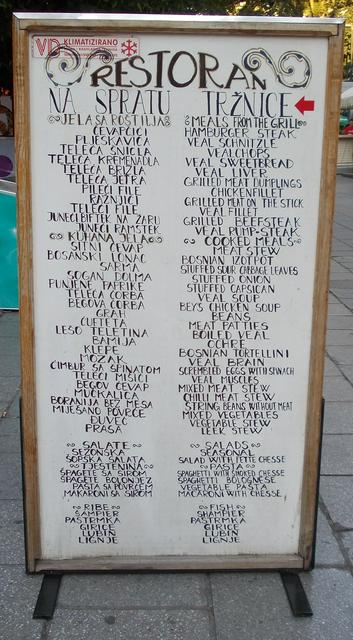 Smoked meats are a staple of Bosnian cuisine, more so than the stereotypical foods of pita & cevapi. Amongst the non-Muslim populations, pork rules, and prosciutto, smoked neck, smoked ribs, bacon and hundreds of varieties of smoked sausage make this a real BBQ country. The Muslims, of course, have equally-tasty lamb or beef alternatives. The meat is prepared by first curing in salt for several days, which removes water & dehydrates the meat, while the high-concentrations of salt preserve the meat from spoiling. After being rubbed with spices (a Bosnian dry rub is usually very simple, and includes some combination of high-quality fresh peppercorns, hot paprika, salt, onions & garlic, and a few spoons of Vegeta, a powdered chicken soup mix similar to an Oxo flavor cube), the meat is then hung over a heavy smoke made by a wood fire. Fruit trees are well known by BBQ aficionados around the world to produce the most flavorful smoke, and apple, cherry and walnut trees are the most commonly used in Bosnia. Whereas commercially produced deli meats (of the sort you may buy at your local deli) are most often dry-cured or hung in dehydrating fridges and only then pressure-smoked for a few hours to allow some flavor to permeate the meat, Bosnian smoked meat is painstakingly smoked up to three months. The meat hangs in a "smoke house," a tiny wooden shed usually only big enough to light a fire and hang the meat. Bosnians will only smoke meat in the fall or winter, because the low temperatures, together with the salt curation, allow the meat to hang for months without spoiling. During this time, it is smoked up to 4 times a week, for 8–10 hours at a time, which infuses the meat with the flavor of the smoke and removes any remaining water. The finished product has an incredibly strong aroma and flavor of smoke, with the texture of chewy beef jerky. Depending on the cut of meat, the most noticeable difference between smoked meat produced this way and the commercially produced meat available in North America, is the color inside the meat. Whereas commercial deli meat is usually soft, red, a little wet and fairly raw, Bosnian smoked meat is black throughout with only a slight tinge of pink. Larger cuts of meat, like the Dalmatian prosciutto, do tend to be a bit more pink & softer inside, but the difference is still dramatic, since the Balkan-made prosciutto has much less water, is chewier and overall better smoked. Such meat is most often consumed at breakfast time, in sandwiches, or as meza, a snack commonly brought out to greet guests. For the visitor, smoked meats are a cheap and incredibly flavorful lunch meat, and can be bought at Bosnian marketplaces from people who usually prepare it themselves. Have a pork neck sandwich with some Bosnian smoked cheese and a salad of fresh tomatoes in a bun of fresh and crisp homemade bread, and you'll never want to leave.
When you visit a Bosnian at home, the hospitality offered can be rather overwhelming. Coffee is almost always served with some home-made sweet, such as breads, cookies or cakes, together with Meza. Meza is a large platter of arranged smoked meats, which usually includes some type of smoked ham (in traditional non-Muslim homes) and sausage thinly cut and beautifully presented with cheese, ajvar, hard-boiled eggs and freshly cut tomatoes, cucumbers or other salad vegetables. Bread is always served. Most cookbooks on South Slavonic cooking are packed with hundreds of varieties of breads, this being one of the most bread-crazy regions in the whole world. Yet, just about the only type of bread in most Bosnians' homes is the store-bought French variety, which the Bosnians, of course, would never dream of calling "French." To them, it is simply "Hljeb" or "Kruh".
However, more of an effort is made at special occasions to produce traditional Slavonic breads, and each family usually bakes its own variation of a traditional recipe. At Christmas & Easter, Orthodox Serb & Croatian Catholic families typically make a butter-bread called Pogaca, which is often braided and brushed with an egg-wash, giving it a glistening finish perfect for impressive holiday tables. During the month of Ramadan, the Bosniak (Muslim) populations bake countless varieties of breads, and the unique and Turkish-inspired varieties are generally more numerous, diverse and dependent on regions and villages than among Christian populations, where special-event recipes are more homogeneous and fewer selections exist. Lepinja or Somun (the bread served with Cevapi) is a type of flat bread, probably introduced in some form to Bosnia by the Turks, but has since developed independently and is only vaguely reminiscent of Turkish or Middle Eastern flat pita breads. Unlike the Greek or Lebanese pita, the Bosnian Lepinja is chewy and stretchy on the inside and pleasantly textured on the outside, making it a perfect spongy companion to oily meats and barbecue flavors. The Turks may have begun this recipe, but the Bosnians have taken it to a whole new high.
In every-day cooking, Bosnians eat lots of stew-type meals, like Kupus, a boiled cabbage dish; Grah, beans prepared in a similar fashion, and a fairly-runny variation of Hungarian goulash. All are made with garlic, onions, celery and carrots, followed by a vegetable, smoked meat and several cups of water. This is then cooked until the vegetables are falling apart. A local spice called "Vegeta" is incorporated into almost every dish, and the same spice is used throughout the region, as far as Poland. It is the North American equivalent of a chicken Oxo cube, or, in other words, condensed chicken broth mix. These type of stew meals will cost you next to nothing, and are very hearty filling meals.
-YNuoD.medium.JPG) As for desserts, you will drool over ice cream sold in most former Yugoslav countries. There are several varieties, but regional milk and cream must be a contributing factor to their wonderful taste. You can buy ice cream either by the scoop or from an iced-milk swirl machine, packaged in stores or from a sidewalk vendor with a freezer right on the street. Recommended is the "Egypt" Ice Creamery in Sarajevo, famous in the region for their caramel ice cream. Also try "Ledo," a type of packaged ice cream made in Croatia but sold throughout the region. You should also try some local desserts, such as Krempita, a type of a custard/pudding dessert that tastes something like a creamy cheesecake, and Sampita, a similar dessert made with egg whites. Traditional Bosnian desserts are also something to try. Hurmasice or Hurme, is a small finger-shaped wet sweet with walnuts; Tulumbe are something like a tubular doughnut, crispy on the outside and soft and sweet on the inside. And of course, don't forget to try Bosnia's take on the world-famous Baklava, which tends to be somewhat more syrupy than its Turkish counterpart and usually does not contain any rum, like its Greek counterpart. Much of the traditional cooking has Turkish undertones, a colorful consequence of six hundred years of Ottoman rule over most of Bosnia & Herzegovina, and desserts are no different.
As for desserts, you will drool over ice cream sold in most former Yugoslav countries. There are several varieties, but regional milk and cream must be a contributing factor to their wonderful taste. You can buy ice cream either by the scoop or from an iced-milk swirl machine, packaged in stores or from a sidewalk vendor with a freezer right on the street. Recommended is the "Egypt" Ice Creamery in Sarajevo, famous in the region for their caramel ice cream. Also try "Ledo," a type of packaged ice cream made in Croatia but sold throughout the region. You should also try some local desserts, such as Krempita, a type of a custard/pudding dessert that tastes something like a creamy cheesecake, and Sampita, a similar dessert made with egg whites. Traditional Bosnian desserts are also something to try. Hurmasice or Hurme, is a small finger-shaped wet sweet with walnuts; Tulumbe are something like a tubular doughnut, crispy on the outside and soft and sweet on the inside. And of course, don't forget to try Bosnia's take on the world-famous Baklava, which tends to be somewhat more syrupy than its Turkish counterpart and usually does not contain any rum, like its Greek counterpart. Much of the traditional cooking has Turkish undertones, a colorful consequence of six hundred years of Ottoman rule over most of Bosnia & Herzegovina, and desserts are no different.
Whatever you eat in Bosnia, you will notice the richness of the flavors you thought you knew. The cuisine of the country has not yet been ruined by commercially-grown produce, so most foods are (uncertified) organically or semi-organically grown, using fewer chemicals and are picked when ripe. The vegetable markets sell only seasonal and locally-grown vegetables, and you are bound to have some of the best tasting fruit you've ever tried in the Neretva Valley region of Herzegovina (close to the Croatian border, between Mostar and Metkovic). The region is famous for peaches, mandarin oranges, peppers & tomatoes, cherries (both the sweet and the sour variety), watermelons and most Kiwi fruits. Cheese is also incredibly flavorful and rich all across Bosnia & Herzegovina, and generally all foods are as fresh as it gets. Enjoy!
Aščinica — a storefront restaurant serving cooked (as opposed to grilled or baked).
Buregdžinica — a place where the main dishes are filled pastries (burek, sirnica, etc).
The legal drinking age in Bosnia and Herzegovina is 18 years. Popular domestic beers are Nektar (from Banja Luka), Sarajevsko, Preminger (from Bihać, made according to a Czech recipe) and Tuzlansko, while the most common imports are Ozujsko and Karlovačko from Croatia, Jelen from Serbia, and Laško and Union from Slovenia. Like in almost every European country, beer is very common and popular. Even in more heavily Islamic areas alcohol is available in abundance to those who choose to drink and almost every bar is fully stocked.
Like most Slavs, Bosnians make 'Rakija' which comes in many a variety and is made both commercially and at home. Red wine is 'Crno vino' (Black wine) and white wine is 'bijelo vino'. Wines from Herzegovina are renowned for their quality. Alcohol is not taxed as heavily as in most Western nations and is often very affordable. Quality alcohol is sought after and valued.
Another popular drinking beverage is Turkish coffee, in Bosnia called Bosnian or domaca (homemade) coffee, which can be bought in every bar, coffee shop or fast food place.
Bosnians are among the heaviest coffee drinkers in the world.
-hyHoR.medium.jpg) Be careful when traveling off the beaten path in Bosnia and Herzegovina: it is still clearing many of the estimated 5 million land mines left around the countryside during the Bosnian War of 1992-1995. In rural areas try to stay on paved areas if possible. Never touch any explosive device. Houses and private properties were often rigged with mines as their owners fled during the war. If an area or property looks abandoned, stay away from it.
Be careful when traveling off the beaten path in Bosnia and Herzegovina: it is still clearing many of the estimated 5 million land mines left around the countryside during the Bosnian War of 1992-1995. In rural areas try to stay on paved areas if possible. Never touch any explosive device. Houses and private properties were often rigged with mines as their owners fled during the war. If an area or property looks abandoned, stay away from it.
Bosnia experiences very little violent crime. In the old centre of Sarajevo, be aware of pickpocketing.
All Bosnian employees undergo regular health checks to ensure that they can physically do their jobs and that they will not transmit any disease or injure anyone. People in the food industry are particularly checked and random health and safety checks for the premises are held often. Food handlers and providers are held to the highest standards. Bosnian kitchens and food storehouses are expected to be sanitary and spotless and food safety is very important.
Tap water is drinkable.
If getting a tattoo, ensure that the instruments are sterilised. While this may be a common practice, one should still be careful.
Since the food is rich, some extra exercise may help.
And as above, never walk off dedicated paths in case of land mines.
Smoking is allowed nearly everywhere in the country, and over half the population use tobacco. Therefore, be prepared to endure very smoky restaurants, bars and shopping centres, as well as other establishments. Even bus drivers often smoke while driving.
Respect the religious differences of the people in the region and their effort to move past the Yugoslavian civil war. Be careful in areas where there is still tension and to ensure that you do not offend a particular group.
Similarly, respect the environment. A lot of the country, as well as its neighbours, have been spared from pollution and it is very important to be careful of your influences.
The creeks and rivers tend to be fierce, the mountains and valleys often unguarded and the footing unsure. Always have a tour guide with you or consult a local for advice on the natural dangers and land mines.
Each entity has its own postal service, so stamps bought in the Federation cannot be used in the RS and vice versa.
There are only three mobile phone networks in Bosnia and Herzegovina: HT ERONET (Mostar), GSMBiH (Sarajevo) and m:tel (Republika Srpska, Banja Luka). You can buy a prepaid SIM card from any network at any kiosk for KM10 or less.